
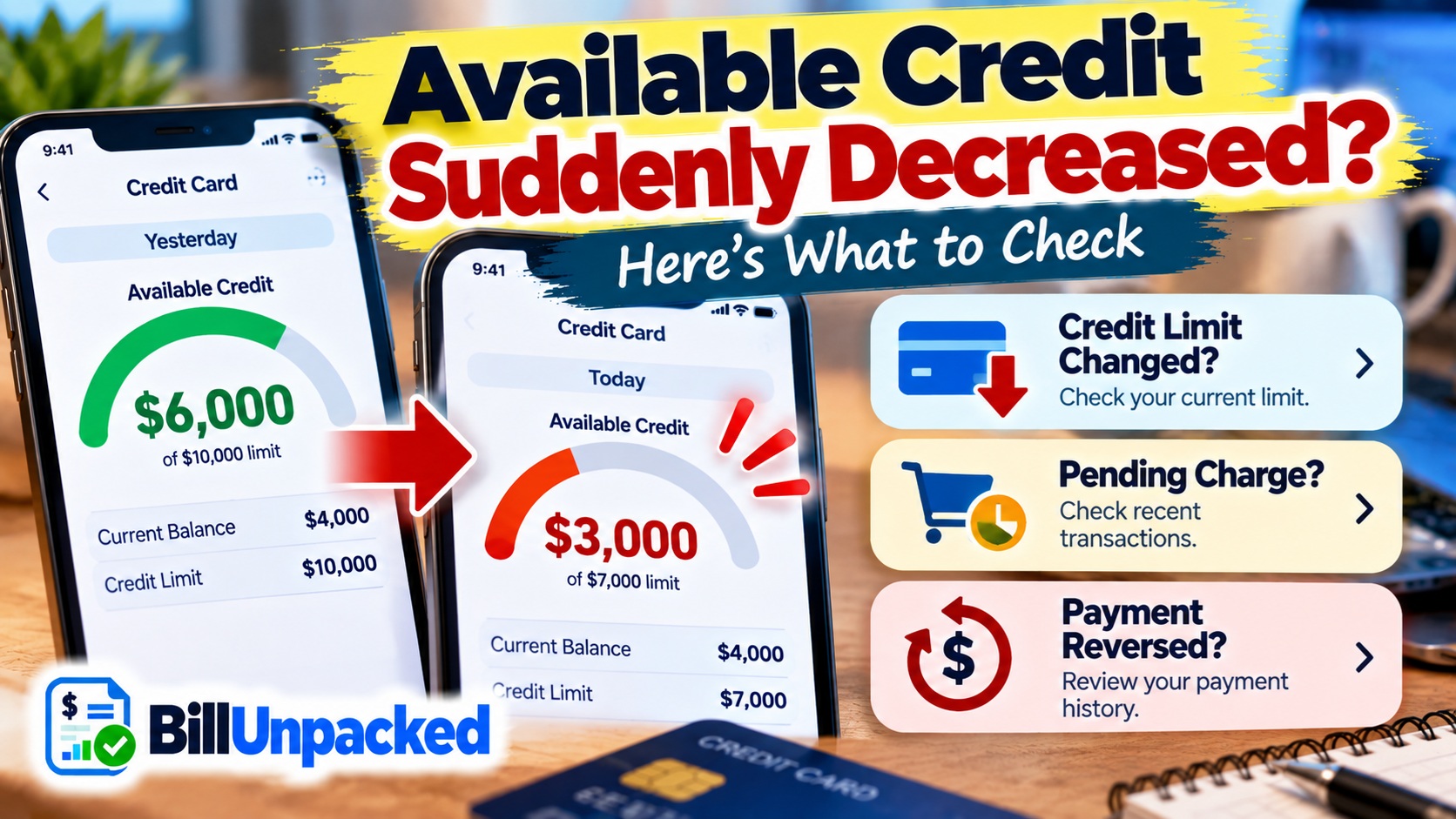
You open your credit-card app and discover that yesterday you had $3,000 of available credit, but today you have only $1,500—even though you don’t remember spending another $1,500.
The key is to determine which number changed.
Why Did My Available Credit Suddenly Go Down?
Available credit is not the same thing as your credit limit.
Your credit limit is the maximum credit line currently assigned to the account. Your available credit is the portion currently shown as available for use.
If available credit falls unexpectedly, investigate the account before assuming the card company made a mistake.
1. Check for a New Pending Charge
Start with the pending-transactions section of your card account.
A merchant may obtain an authorization before the transaction becomes a final posted charge. During that period, the authorization can affect the credit available to you.
This is particularly worth checking after transactions involving:
- Hotels
- Rental cars
- Restaurants
- Gas stations
- Online orders
- Other merchants that authorize an amount before final settlement
2. Check Whether Your Credit Limit Changed
This is one of the most important checks because a lower credit limit can cause available credit to fall even when you haven’t made another purchase.
The Consumer Financial Protection Bureau says credit-card companies generally can increase or decrease a consumer’s credit limit. An issuer can reduce the limit enough that a consumer no longer has available credit.
Example
| Yesterday | Today | |
|---|---|---|
| Credit limit | $10,000 | $7,000 |
| Balance | $4,000 | $4,000 |
| Simple available amount | $6,000 | $3,000 |
In this simplified example, the balance did not increase at all. The available amount fell because the credit line itself was reduced by $3,000.
Can a Credit Card Company Lower My Limit Without Warning?
A credit-limit decrease does not work exactly like every other change to a credit-card agreement.
CFPB guidance says issuers generally can lower credit limits. CFPB’s Regulation Z commentary also identifies a change in a consumer’s credit limit as an example of a change that does not require the ordinary change-in-terms notice.
There are, however, separate protections involving consequences of the decrease. Regulation Z provides that if an issuer decreases a credit limit, advance notice is required before it can impose an over-the-limit fee or penalty rate solely because the balance exceeds the newly reduced limit. The applicable notice must be provided at least 45 days before imposing those consequences.
Will the Issuer Tell Me Why My Credit Limit Was Reduced?
Often there is another important notice to look for: an adverse action notice.
CFPB says that in most instances when an issuer makes certain unfavorable changes—such as decreasing an existing credit limit—the issuer generally must provide an adverse-action notice.
The notice should either state specific reasons for the action or tell you how to request the specific reasons.
3. Did a Credit Card Payment Get Reversed?
Suppose you owed $4,000 and paid $1,000. Your available credit appeared to increase after the payment.
If that payment is later returned or reversed, the credit created by the payment can disappear again.
Check the payment history for words such as:
- Returned
- Reversed
- Failed
- Rejected
- Payment returned
If that’s what happened, see: Credit Card Payment Reversed? What It Means & What to Do .
4. Did You Make Purchases After Your Payment?
Sometimes nothing is actually missing.
A payment can increase available credit while new purchases reduce it again. When several transactions occur close together, looking only at the payment can make the final available-credit number seem incorrect.
Review transactions chronologically from the day before the payment through today.
5. Did a Merchant Authorization Change?
Pending activity can make the account harder to interpret because the amount initially authorized can differ from the amount eventually posted.
Rather than calculating from posted transactions alone, compare the pending section and posted section.
6. Is There an Unrecognized Transaction?
If available credit decreased and you discover a transaction you genuinely do not recognize, treat that as a separate issue.
Do not assume an unfamiliar merchant descriptor automatically means fraud; merchant names on card statements can differ from the business name you remember.
But if you cannot identify the transaction after reviewing your records, contact the card issuer using the number on the back of your card or another official channel.
Available Credit Drop Calculator
This simple calculator helps determine whether the decrease might be explained by a change in your credit limit or balance.
Where Did My Available Credit Go?
Enter yesterday’s and today’s account figures.
What Should I Check First?
If the limit changed, you’ve immediately identified one major reason the available-credit number changed.
Look for authorizations that may not yet appear in the posted balance.
Check for recent purchases, fees, adjustments or other activity.
Make sure a payment you were relying on has not been returned or reversed.
If the credit limit changed, check secure messages, email and mail for an explanation or adverse-action notice.
Ask specifically whether your credit limit changed or whether an authorization, payment issue or account restriction is affecting available credit.
What If Available Credit Dropped After I Made a Payment?
This deserves a slightly different diagnosis.
First check whether the payment is still pending. If the payment has posted but the available credit has not increased as expected, see our dedicated guide:
Available Credit Not Updated After Payment? What to Check .
If the payment disappeared or was reversed, investigate the payment rather than assuming this is simply an available-credit calculation problem.
Does a Lower Available Credit Mean My Credit Limit Was Cut?
No.
A lower available-credit number by itself does not prove that the issuer reduced your credit limit.
That’s why the first comparison should always be:
- Old credit limit vs. current credit limit
- Old balance vs. current balance
- Pending transactions
- Recent payment activity
Only call it a credit-limit decrease when the actual credit limit has changed.
What If My Credit Limit Really Was Reduced?
Read any notice from the issuer carefully.
CFPB says an adverse-action notice associated with a limit decrease should either provide the specific reasons for the action or explain how you can request those reasons.
Do not assume the reason is automatically a missed payment. CFPB research has previously found credit-line decreases can occur for reasons beyond a recent delinquency, including changes in a consumer’s credit profile, internal account-performance information or an institution’s risk management.
“My available credit decreased. Did my credit limit change, or is a pending authorization, payment issue or other account restriction affecting the amount I can use?”
Quick Answers
| Question | Answer |
|---|---|
| Why did my available credit decrease? | Check for a lower credit limit, pending or posted transactions, a returned payment and other recent account activity. |
| Can my issuer reduce my credit limit? | Yes. CFPB says credit-card issuers generally can increase or decrease credit limits. |
| Does lower available credit prove my limit was reduced? | No. Compare the actual credit-limit figure before reaching that conclusion. |
| Can a pending transaction affect available credit? | Pending authorizations can affect the amount of credit available even before a transaction reaches its final posted state. |
| What if my payment was reversed? | A returned or reversed payment can remove credit that appeared to have been restored by the payment. |
Bottom Line
If your available credit decreased for no apparent reason, don’t start by guessing why.
Compare the actual credit limit, current balance, pending transactions and payment history.
If your credit limit itself was lowered, CFPB confirms that card issuers generally can reduce an existing credit line. Look for an adverse-action notice explaining the reason or how to obtain it.
If the limit did not change, investigate pending authorizations, new transactions and recent payments. If the numbers still don’t make sense, contact the issuer using an official contact method.
Authoritative Sources
Consumer Financial Protection Bureau:
Can my credit card issuer reduce my credit limit?
Consumer Financial Protection Bureau:
Why did I get a low credit limit on a credit card?
Consumer Financial Protection Bureau — Regulation Z:
§ 1026.9 — Subsequent Disclosure Requirements
Independent consumer information: BillUnpacked is not a bank, lender, card issuer or payment network. This page provides general educational information. Your issuer’s records, card agreement and current account status determine your actual available credit.