
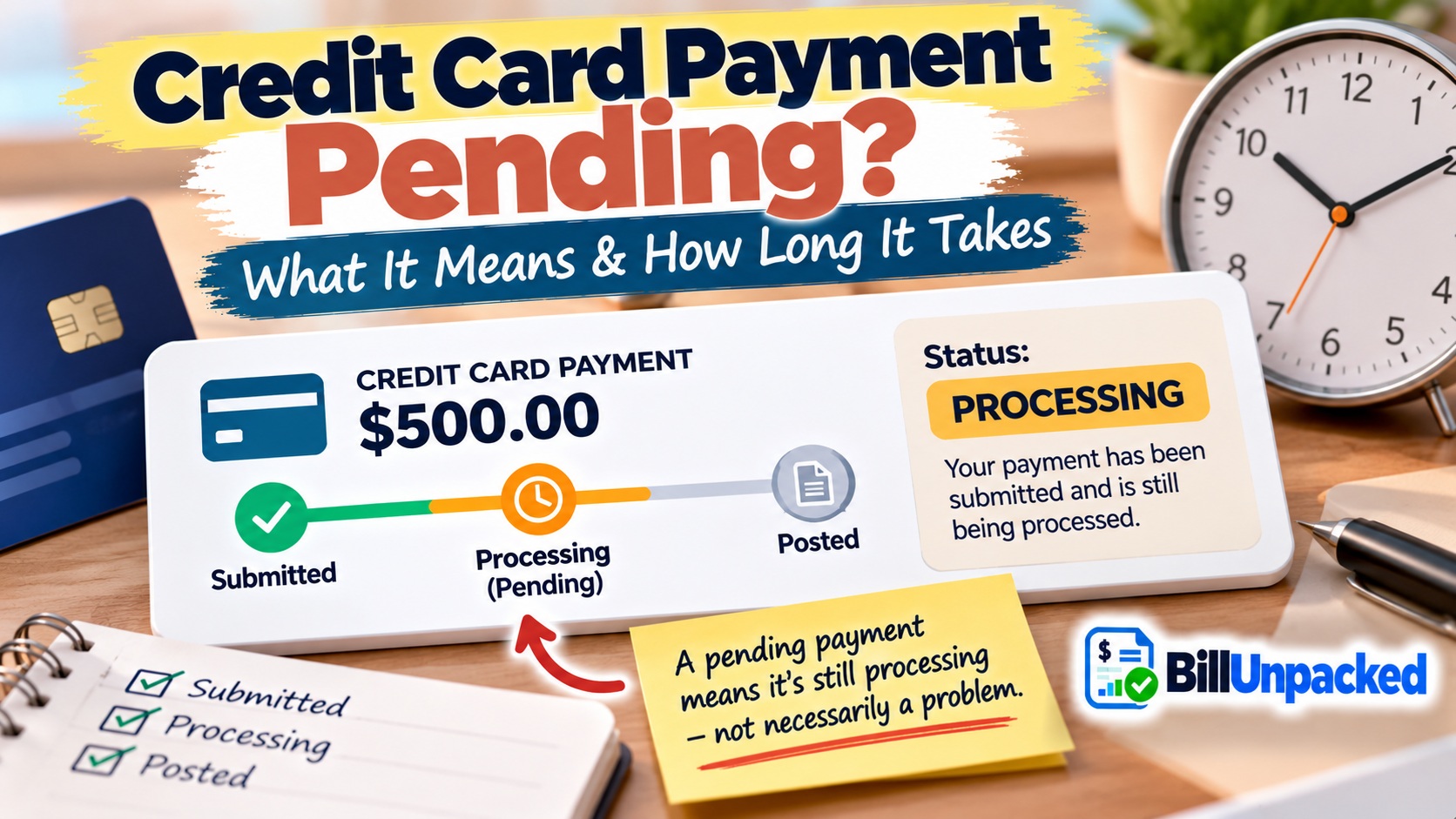
If your credit card payment is pending, the payment has usually been submitted but your account is still displaying it as processing rather than fully posted. Do not assume that “pending” means the payment failed—or that your available credit must update immediately. Check the payment confirmation, amount, due date, funding bank account and your issuer’s current payment status before submitting the same payment again.
What Does “Pending Payment” Mean on a Credit Card?
A pending credit-card payment generally describes a payment toward your card account that has not yet reached the issuer’s final displayed status.
That is different from a pending purchase.
| Pending Card Payment | Pending Purchase | |
|---|---|---|
| Money direction | You are paying the card issuer. | You are buying from a merchant. |
| Purpose | Reduces the amount you owe when credited. | Represents merchant transaction activity. |
| Common concern | “Did my bill payment go through?” | “Did the merchant charge me?” |
| Related guide | This article | Pending Charge on a Credit Card |
How Long Does a Credit Card Payment Stay Pending?
There is no single universal number of hours or days that applies to every issuer, payment method and account display.
The CFPB specifically says that how long it takes before you can use available credit again after making a payment depends on the card issuer’s policy, how much you paid and how much you want to charge.
That means a generic promise such as “your available credit will always update in 24 hours” would not be accurate for every credit-card account.
What Should I Check When My Payment Is Pending?
Confirm the Payment Was Actually Submitted
Look for a confirmation in your card account, email or payment history.
Verify:
- Payment amount
- Payment date
- Funding account
- Confirmation number, if provided
- Current payment status
Do not submit a second payment simply because the first one has not yet changed to “posted.”
Check the Bank Account Funding the Payment
If you paid electronically from a checking or savings account, check that account too.
You may see:
- No debit yet
- A pending debit
- A completed debit
- A debit that was later returned
The bank-side status can provide useful context, but it does not replace the card issuer’s official payment status.
Check Your Due Date
If the due date is close, determine whether the issuer considers the payment received on time rather than relying only on the word “pending.”
For a conforming payment, Regulation Z generally requires crediting as of the date the creditor receives it, subject to specific rules and exceptions.
Check Whether Your Available Credit Updated
Your balance, payment status and available credit may not all change at exactly the same moment in the interface.
If you need to make another purchase, check the available credit shown by your issuer.
If it has not increased after a payment, the CFPB recommends checking with the issuer because the timing depends on issuer policy and the circumstances.
Credit Card Payment Status Checker
Use this tool to organize what you are seeing and identify the next useful check. It cannot access your actual account.
What Should I Do About My Pending Payment?
Enter the payment information currently shown in your accounts.
Is My Pending Payment Considered On Time?
The word pending by itself does not answer that question.
Under current Regulation Z, a creditor generally must credit a conforming payment as of the date it is received, except in circumstances covered by the regulation’s exceptions.
For online payments made through the creditor’s website, the official interpretation provides specific rules for determining the date of receipt. For example, an immediately authorized payment submitted after a creditor’s permitted cut-off time may be deemed authorized on the next business day.
Why Hasn’t My Available Credit Increased?
A common reason people search for “credit card payment pending” is that they made a payment specifically to free up credit for another purchase.
Do not assume that the available-credit number must increase immediately after you press the payment button.
The CFPB says the time before you can use the card again after using all your credit and making a payment depends on:
- The card issuer’s policy
- How much you paid
- How much you want to charge
If you need the available credit for an upcoming purchase, contact the issuer rather than relying on a universal processing estimate.
Can a Payment Be Credited but Still Look Pending?
The concepts of crediting and posting/displaying are not identical under Regulation Z.
The CFPB’s official interpretation of §1026.10 explicitly says the rule does not require a creditor to post the payment on a particular date. Instead, it generally requires the payment to be credited as of the date of receipt.
You make a conforming payment through the issuer’s website.
Your app may continue showing a processing status for some period.
That visible status alone does not establish the legal crediting date.
What If My Payment Never Shows on the Statement?
That is more serious than merely seeing a temporary pending status.
Current CFPB guidance says that if a payment does not appear on your credit-card statement, you should contact the card company. To preserve your billing-error rights, CFPB also says to send a written billing-error notice within 60 days of receiving the statement that should have reflected the payment.
Follow the billing-error instructions on your statement because the billing-error address is generally different from the payment address.
Should I Make Another Payment While the First Is Pending?
First determine what happened to the original payment.
Submitting the same payment again without checking can potentially create an overpayment if both payments ultimately complete.
For example:
| Action | Amount |
|---|---|
| Original payment still processing | $500 |
| Second payment submitted | $500 |
| If both complete | $1,000 total paid |
If the resulting credits exceed what you owe, you could end up with a credit balance.
See: Negative Balance on Credit Card? What It Means.
What If the Pending Payment Is Later Reversed?
A payment that changes from pending to returned, reversed or failed needs a different diagnosis.
Check whether the funding bank account honored the payment and review the current amount due on the card.
Use our separate guide: Credit Card Payment Reversed? What It Means & What to Do.
Can My Issuer Charge a Fee Just for Making a Payment?
Regulation Z generally prohibits a separate fee merely for allowing a consumer to make a credit-card payment by a particular method.
An exception exists for certain expedited payment services involving assistance from a live customer-service representative.
That is different from a potential late fee or a fee associated with a returned payment under applicable account terms.
What If My Issuer Credited the Payment Incorrectly?
Regulation Z says that if a creditor fails to credit a payment as required and the failure causes finance or other charges, the creditor must adjust the account so that those qualifying charges are credited during the next billing cycle.
If you believe a correctly submitted payment was credited incorrectly, keep:
Useful Payment Records
- Payment confirmation
- Payment amount
- Date and time submitted
- Funding account information
- Bank transaction showing the debit
- Card payment history
- Statement showing the problem
- Any late fee or finance charge related to the issue
Pending Payment vs. Reversed Payment
| Status | General Meaning | Best Next Check |
|---|---|---|
| Pending | Payment is still displayed as processing. | Check confirmation, funding account and due date. |
| Posted | Payment appears completed in the card account. | Confirm balance and available credit. |
| Returned / Reversed | Payment did not remain successfully credited. | Check the funding bank account and issuer’s reason. |
| Missing from statement | A payment you made is not reflected where expected. | Contact issuer and consider the billing-error process. |
5-Minute Pending Payment Checklist
Check These Before Paying Again
- Confirm the payment amount.
- Save the confirmation number.
- Check the card-side payment status.
- Check the funding bank account.
- Review your payment due date.
- Check the issuer’s payment cut-off time.
- Look at the current minimum payment due.
- Check whether available credit has changed.
- Do not assume a second payment is necessary.
- Contact the issuer if the statuses conflict.
Bottom Line
A credit card payment showing as pending does not automatically mean it failed or that it will be considered late.
Check the payment confirmation, funding account, due date and the issuer’s official payment status. Federal rules generally focus on when a conforming payment is received and credited, while the date your app visibly changes the payment to “posted” can be a separate matter.
And if you are waiting for your available credit to return, there is no universal timeline—the CFPB says that depends on the issuer’s policy and the circumstances.
Authoritative Sources
Consumer Financial Protection Bureau — Regulation Z §1026.10:
Payments
Consumer Financial Protection Bureau:
How Long Before I Can Use My Credit Card Again After Making a Payment?
Consumer Financial Protection Bureau:
When Is My Credit Card Payment Considered Late?
Consumer Financial Protection Bureau:
What If My Payment Does Not Show on My Statement?