
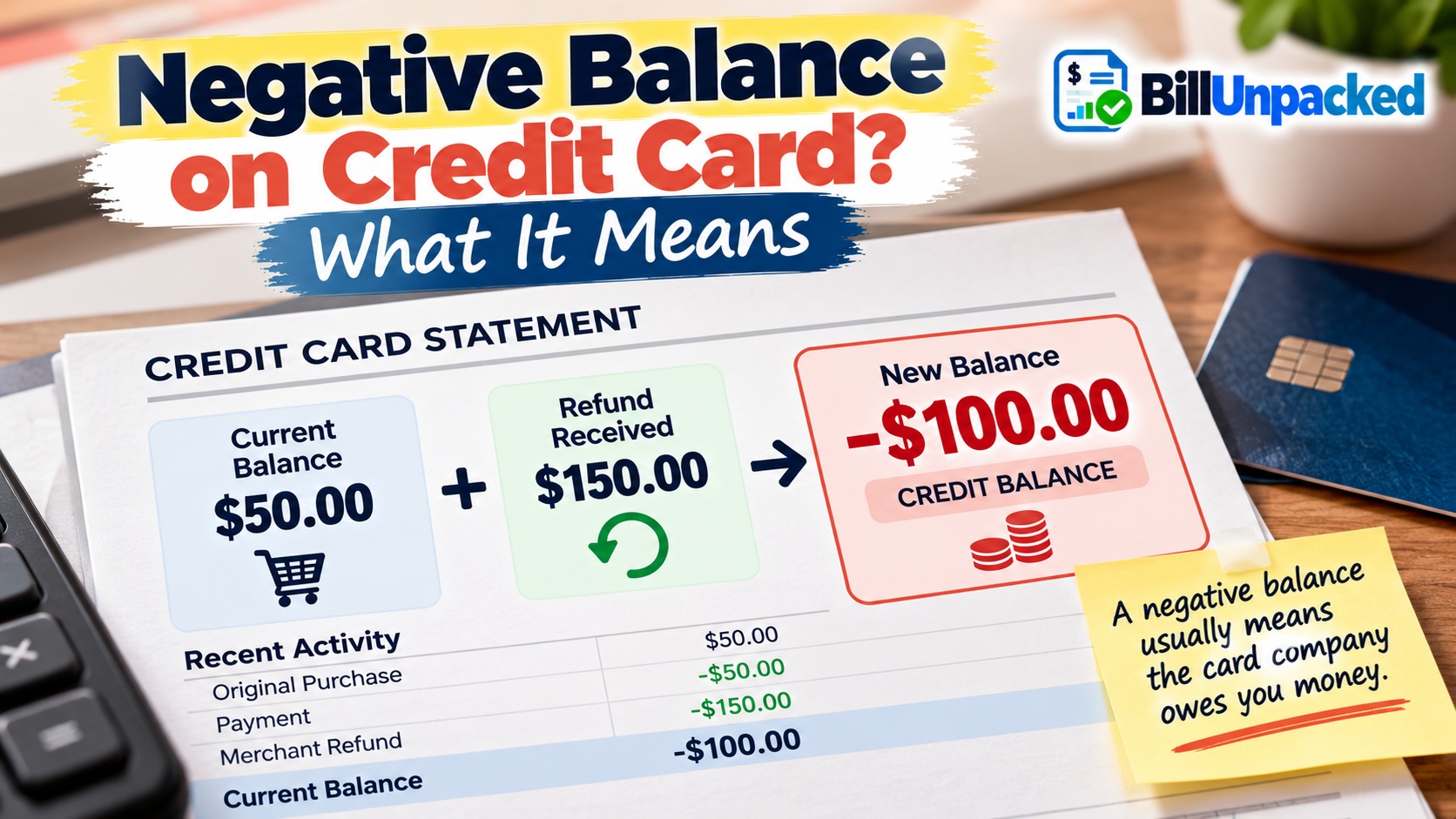
A negative balance on a credit card usually means the card company owes you money. For example, if your balance was $50 and a $150 refund was credited afterward, your account could show -$100. This is commonly called a credit balance. You can generally leave the credit on the account for future purchases or ask the card company to return the money.
Why Is My Credit Card Balance Negative?
A negative balance can appear when credits applied to the card exceed the outstanding balance.
Common examples include:
The Consumer Financial Protection Bureau describes a credit balance as money that the credit-card company owes you.
Negative Credit Card Balance Example
| Account Activity | Effect | Balance |
|---|---|---|
| Existing card balance | Amount owed | $50 |
| Merchant refund | -$150 credit | -$100 |
| Result | Credit balance | -$100 |
In this example, the refund is larger than the amount still owed. The extra $100 therefore becomes a credit balance.
Credit Balance Calculator
Use this calculator to estimate whether a refund or payment would leave your card with an amount due or a credit balance.
Will My Card Have a Negative Balance?
Enter your current balance and the new refund, payment or other credit.
Is a Negative Credit Card Balance Bad?
A negative balance by itself means something very different from an unpaid positive balance.
It generally represents money credited to the account beyond what was owed.
Instead of immediately trying to “pay” a negative balance, first identify the transaction that created it.
What Can Cause a Negative Credit Card Balance?
1. A Refund Arrived After You Paid the Bill
Suppose you purchased something for $200 and later paid your card balance.
If the merchant subsequently sends a $200 refund to that card account, there may no longer be an outstanding $200 balance for the refund to offset.
That refund can therefore create a credit balance.
If you’re still waiting for the merchant credit, see Credit Card Refund Not Showing? 8 Things to Check.
2. You Paid More Than the Total Balance
An overpayment can also create a credit balance when the amount credited to the account exceeds the total amount you owe.
Total balance: $300
Payment credited: $350
Potential resulting credit balance: -$50
Note that paying more than your minimum payment due is not necessarily an overpayment. You can pay substantially more than the minimum while still owing a positive total balance.
3. A Billing Correction Was Applied
If the issuer corrects an earlier billing error, the resulting credit could exceed your remaining balance.
4. A Reward or Other Account Credit Was Added
Depending on the account and how a reward is redeemed, a statement credit or another adjustment can contribute to a credit balance.
Can I Spend a Negative Credit Card Balance?
CFPB consumer guidance says you do not necessarily have to take action when you have a credit balance. You can leave the credit on the account to be applied against future charges.
For example, suppose your card shows:
| Activity | Illustrative Balance |
|---|---|
| Starting credit balance | -$100 |
| New purchase | +$35 |
| Illustrative remaining credit | -$65 |
This is only a simplified example. Your actual balance can be affected by other purchases, payments, fees, interest and credits.
Can I Ask the Credit Card Company to Send Me the Money?
Yes.
CFPB consumer guidance says you can ask the credit-card company to refund a credit balance. The company may ask you to make the request in writing.
More importantly, current Regulation Z provides specific protection for credit balances greater than $1.
The regulation’s official interpretation also says creditors may refund the balance sooner and may honor oral or electronic requests. The seven-business-day requirement specifically applies to the written-request provision.
Does Every -$1 Balance Have the Same Federal Refund Rule?
No. The specific Regulation Z provision discussed above applies when a credit balance is in excess of $1.
The regulation’s official interpretation says the ultimate treatment of a credit balance of $1 or less can depend on other applicable law.
For a small balance, check your issuer’s account terms or contact it directly.
What Happens If I Leave the Credit Balance There?
You can generally leave it on the card and allow future purchases to reduce it.
Regulation Z also addresses credit balances that remain for more than six months. For a covered credit balance, the creditor must make a good-faith effort to refund the remaining amount.
The regulation says this may be done by cash, check, money order, or credit to a deposit account.
If the creditor cannot determine your current location after the required effort, the federal rule does not require further action under that provision.
Should I Request a Refund or Leave the Credit on the Card?
That depends on what you want to do with the money.
| Your Situation | Possible Action |
|---|---|
| You regularly use the card | You may leave the credit to offset future purchases. |
| You want the money returned | Ask the issuer how to request a credit-balance refund. |
| You want the federal written-request protection | Follow the issuer’s instructions for submitting a written request. |
| You do not recognize the credit | Review account activity and contact the issuer before assuming what caused it. |
How Do I Request a Credit Balance Refund?
Start by checking your card issuer’s official website, app or the customer-service information on your statement.
Have the following information available:
- Your name
- Account information requested by the issuer
- The amount of the credit balance
- Your preferred refund method, if options are offered
- Your current mailing/contact information
If the issuer requires a written request—or you want to rely on Regulation Z’s written-request provision—follow the issuer’s instructions for where that request should be sent.
Will a Negative Balance Increase My Credit Limit?
A credit balance and your contractual credit limit are different concepts.
Do not assume that having a $500 credit balance permanently increases a $5,000 credit limit to $5,500.
If you are planning a purchase near or above your normal credit limit, ask your issuer how a credit balance affects available credit and transaction authorization on your specific account.
Does a Negative Balance Mean My Refund Arrived?
It can—but check the transactions rather than relying only on the balance.
If you recently expected a merchant refund and the account suddenly moved below zero, look for the corresponding refund or credit entry and compare its amount with the merchant’s confirmation.
For refund timing, see Credit Card Refund Pending? How Long Does It Take?.
What If My Negative Balance Looks Wrong?
Review the account activity that created it.
Check These Items
- Recent payments
- Merchant refunds
- Statement credits
- Rewards credits
- Billing adjustments
- Reversed transactions
- Pending purchases
- Your previous statement balance
If you cannot explain the balance after reviewing the account, contact the issuer through an official channel.
Negative Balance vs. Amount You Owe
| Example Display | General Meaning |
|---|---|
| $500 balance | Typically indicates an amount owed, subject to the issuer’s display conventions. |
| -$100 credit balance | Typically indicates the account has $100 more in credits than the amount owed. |
| $0 balance | No positive or negative balance in this simplified example. |
Always check your issuer’s terminology because apps and statements may display credit balances differently.
5-Minute Credit Balance Checklist
Before Taking Action
- Confirm the balance is actually a credit balance.
- Look for the transaction that created it.
- Check whether a merchant refund recently arrived.
- Review recent payments for an overpayment.
- Check for statement credits or adjustments.
- Decide whether you want to use the credit for future purchases.
- If you want the money returned, contact your issuer.
- For a covered balance over $1, consider a written refund request.
- Keep a copy of any written request.
Bottom Line
A negative balance on a credit card generally means you have a credit balance—the card company owes you money rather than the other way around.
Refunds, overpayments and other account credits can create it. You can generally leave the credit on the account to offset future purchases or ask the issuer to return the money.
For a covered credit balance greater than $1, current Regulation Z requires the creditor to credit the amount to your account and generally refund any remaining amount requested in writing within seven business days after receiving that request.
Authoritative Sources
Consumer Financial Protection Bureau — Consumer FAQ:
What Is a Credit Balance on My Credit Card Bill?
Consumer Financial Protection Bureau — Regulation Z §1026.11:
Treatment of Credit Balances; Account Termination
Consumer Financial Protection Bureau — Regulation Z:
12 CFR Part 1026 — Truth in Lending (Regulation Z)