
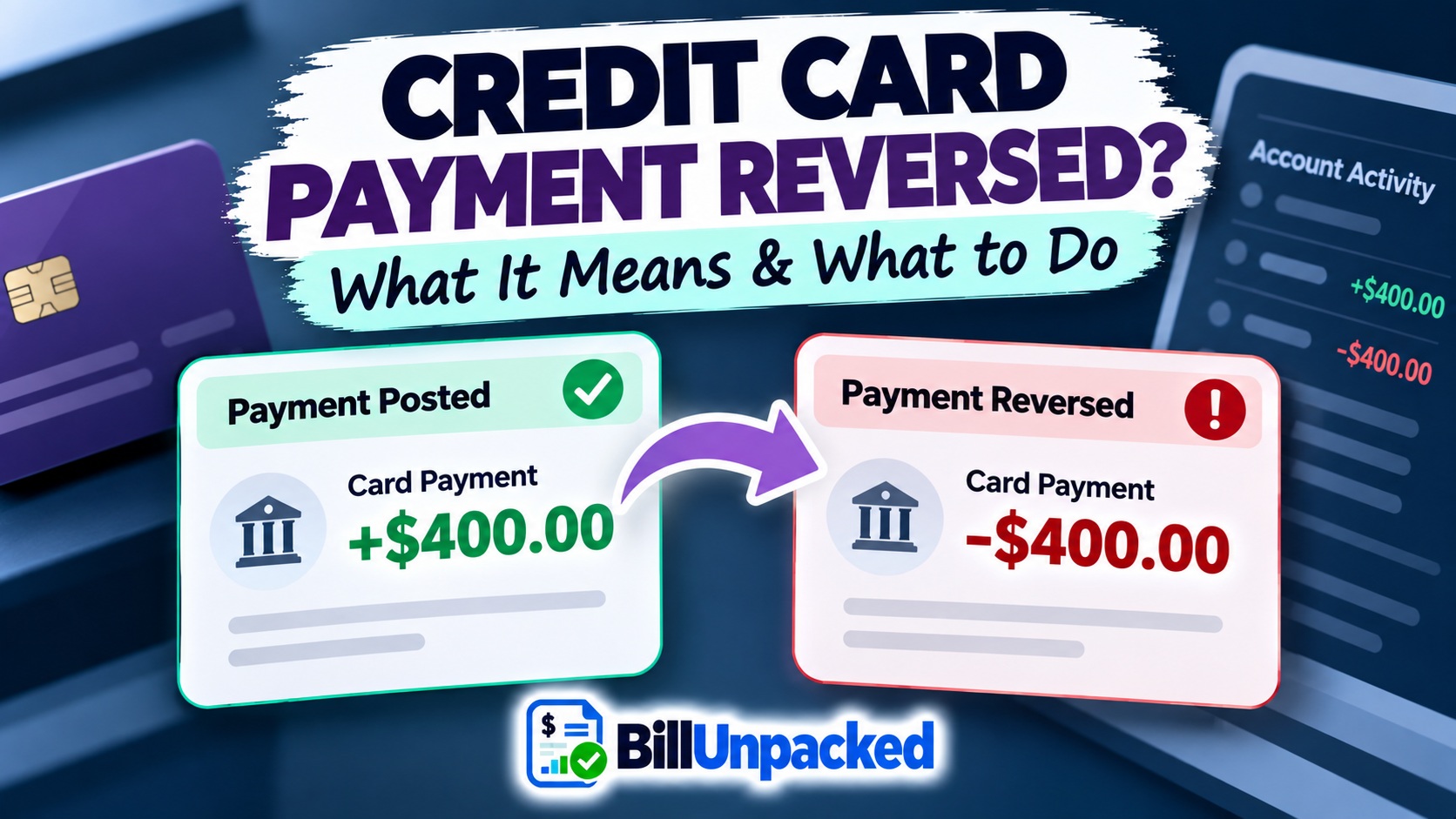
If your credit card payment was reversed, a payment that initially appeared on the card account may no longer be reducing your balance. One possibility is a returned payment—a payment that your financial institution did not honor. Check both your card account and the bank account used for the payment before submitting another payment, because “payment reversed” is different from a merchant purchase being reversed.
What Does a Credit Card Payment Reversal Mean?
There are two very different transactions people often call a “credit card reversal.”
| Transaction | What Is Being Reversed? | What You May Notice |
|---|---|---|
| Payment reversal / returned payment | Money you attempted to pay toward your credit-card account | Your card balance may increase again after the payment credit is removed. |
| Purchase reversal | A merchant purchase or authorization | A charge may disappear or be credited back. |
This article is about the first situation: a payment made toward your credit-card bill.
If instead a merchant transaction disappeared or was reversed, read Reversed Credit Card Charge: What Does It Mean?.
What Is a Returned Credit Card Payment?
The Consumer Financial Protection Bureau’s credit-card contract definitions describe a returned payment as a payment you make to the card issuer that is not honored by your financial institution.
In practical terms, your credit-card account might initially reflect the payment, but the payment can later be returned if the transfer is not successfully completed.
Why Can a Credit Card Payment Be Reversed?
The exact reason should come from your card issuer or the financial institution involved. Do not rely solely on a generic label such as “reversed.”
Possible situations to investigate include:
- The financial institution did not honor the payment.
- The payment account did not have enough available funds when collection was attempted.
- The bank-account or routing information entered for the payment was incorrect.
- The payment account was closed, restricted or otherwise unable to complete the transfer.
- A payment was canceled before completion, where the payment method and issuer permitted cancellation.
- The issuer needs you to verify an account-specific payment problem.
These are diagnostic possibilities, not a statement that every reversed payment has one of these causes. Check the exact reason with the institutions involved.
What Should I Do First?
Open the Payment Details
Start with the credit-card account and look at the exact payment status.
Look for terms such as:
- Returned
- Reversed
- Failed
- Rejected
- Canceled
- Processing
Record the payment amount and status before taking further action.
Check the Bank Account Used for the Payment
Next, check the checking or savings account from which the card payment was supposed to be taken.
Determine whether:
- The debit actually completed
- The debit is still pending
- The money was returned to the account
- The debit never appeared
This helps you avoid assuming that the card-side status tells the whole story.
Check Your Credit Card Balance Again
If an earlier payment credit is removed, your card balance can increase again.
For example, imagine a $600 balance followed by a $400 payment:
| Activity | Illustrative Balance |
|---|---|
| Starting balance | $600 |
| $400 payment credited | $200 |
| $400 payment later reversed | $600 |
This simplified example assumes there are no other purchases, fees, interest, payments or credits.
Check the Due Date and Minimum Payment
A reversed payment can matter more if the original payment was intended to satisfy an upcoming or recently passed minimum-payment deadline.
Check your current account information for:
- Payment due date
- Minimum payment due
- Current balance
- Whether the issuer still considers a payment due
Do not assume that an earlier payment attempt still satisfies the amount due after it has been returned.
Credit Card Payment Reversal Checker
Use this tool to organize the situation before contacting your issuer. It does not access your bank or credit-card account.
What Should I Check Next?
Enter what you currently see on both sides of the payment.
Should I Immediately Make the Payment Again?
Not always.
First determine what happened to the original payment.
If the card issuer says the payment was returned and the money remains in your bank account, you may need to make a valid replacement payment if an amount is still due.
But if your bank account shows the money was debited while the card issuer shows the payment as reversed, investigate the mismatch before blindly submitting the same amount again.
Can a Reversed Payment Cause a Late Payment?
It can create a problem if the returned payment means the required payment was not successfully made by the applicable deadline.
Check your current account status instead of assuming that the initial payment submission permanently satisfied the bill.
The CFPB’s model credit-card contract definitions note that a consumer must pay at least the minimum payment by the due date stated on the bill and that an issuer may impose a late-payment fee under the account terms when the minimum is not paid by the due date.
Your specific agreement and circumstances determine what happens on your account.
Can There Be a Returned Payment Fee?
Potentially.
CFPB’s model contract definitions explain that a card agreement may provide for a returned-payment fee when a payment is not honored by the consumer’s financial institution.
The amount and applicability depend on the account agreement and applicable law, so check your actual card agreement rather than assuming a standard fee.
What If the Payment Was Credited Late?
A payment that the creditor actually receives is a different issue from a payment that is returned unpaid.
Current Regulation Z §1026.10 generally requires a creditor to credit a conforming payment to the consumer’s account as of the date of receipt, subject to the regulation’s exceptions and payment requirements.
The official interpretation also explains that the rule does not necessarily require the payment to be visibly posted on that same date. The legal crediting date and the date displayed in an account interface can therefore be different concepts.
Payment received but displayed later is not automatically the same thing as a payment returned unpaid.
What If Late Charges Result From Incorrect Payment Crediting?
Regulation Z provides protections when a creditor fails to credit a payment as required and that failure causes finance or other charges.
Section 1026.10 says the creditor must adjust the account so that qualifying charges caused by the improper crediting are credited to the account during the next billing cycle.
This rule should not be interpreted as requiring an issuer to waive charges when the consumer’s payment itself was legitimately returned unpaid.
Why Did My Balance Suddenly Increase?
Suppose your card initially credited a $500 payment and your balance dropped from $900 to $400.
If that $500 payment is later reversed, the balance could move back toward $900, before considering any other activity.
That does not necessarily represent a new $500 purchase. It may represent removal of the payment credit.
| Example | Card Balance |
|---|---|
| Before payment | $900 |
| After $500 payment credit | $400 |
| After $500 payment reversal | $900 |
What If the Reversal Creates a Different Balance Than Expected?
Look for other account activity that occurred around the same time.
Check for:
- New purchases
- Interest
- Fees
- Merchant refunds
- Statement credits
- Other payments
- Pending transactions that posted
If your account unexpectedly shows a negative number instead, read Negative Balance on Credit Card? What It Means.
Payment Reversal vs. Purchase Reversal
| Payment Reversal | Purchase Reversal | |
|---|---|---|
| Money flow | You → card issuer | Card account → merchant transaction |
| Main issue | Payment toward the card bill did not remain credited | Merchant transaction was reversed/released |
| Balance effect | Amount owed may rise again | Amount owed may decrease or pending charge may disappear |
| First place to check | Card payment activity + funding bank account | Merchant transaction details |
Who Should I Contact?
Start with the institution whose status needs clarification.
Contact the card issuer when you need to know why the payment was returned or how much is currently due.
Contact the bank or credit union used to fund the payment when you need to understand whether the debit was honored, returned or rejected on that side.
Use the official phone number on your statement, card, authenticated banking app or institution’s official website.
What Information Should I Have Ready?
Before Calling
- Payment amount
- Date you submitted the payment
- Payment status shown by the card issuer
- Bank account used for the payment
- Bank-side debit status
- Current credit-card balance
- Current minimum payment due
- Payment due date
- Any returned-payment notice
- Any fee shown after the reversal
Bottom Line
If your credit card payment was reversed, first determine whether it was actually a returned payment rather than a merchant transaction reversal.
Check the card issuer’s payment status, then check the bank account used to fund the payment. If the payment was returned, review your current card balance, minimum payment and due date before deciding what to pay next.
If the bank shows the money was taken but the card issuer shows the payment as reversed, contact the institutions rather than immediately submitting a duplicate payment.
Authoritative Sources
Consumer Financial Protection Bureau — Regulation Z §1026.10:
Payments
Consumer Financial Protection Bureau — Official Interpretation:
Official Interpretation of §1026.10
Consumer Financial Protection Bureau:
Credit Card Contract Definitions