
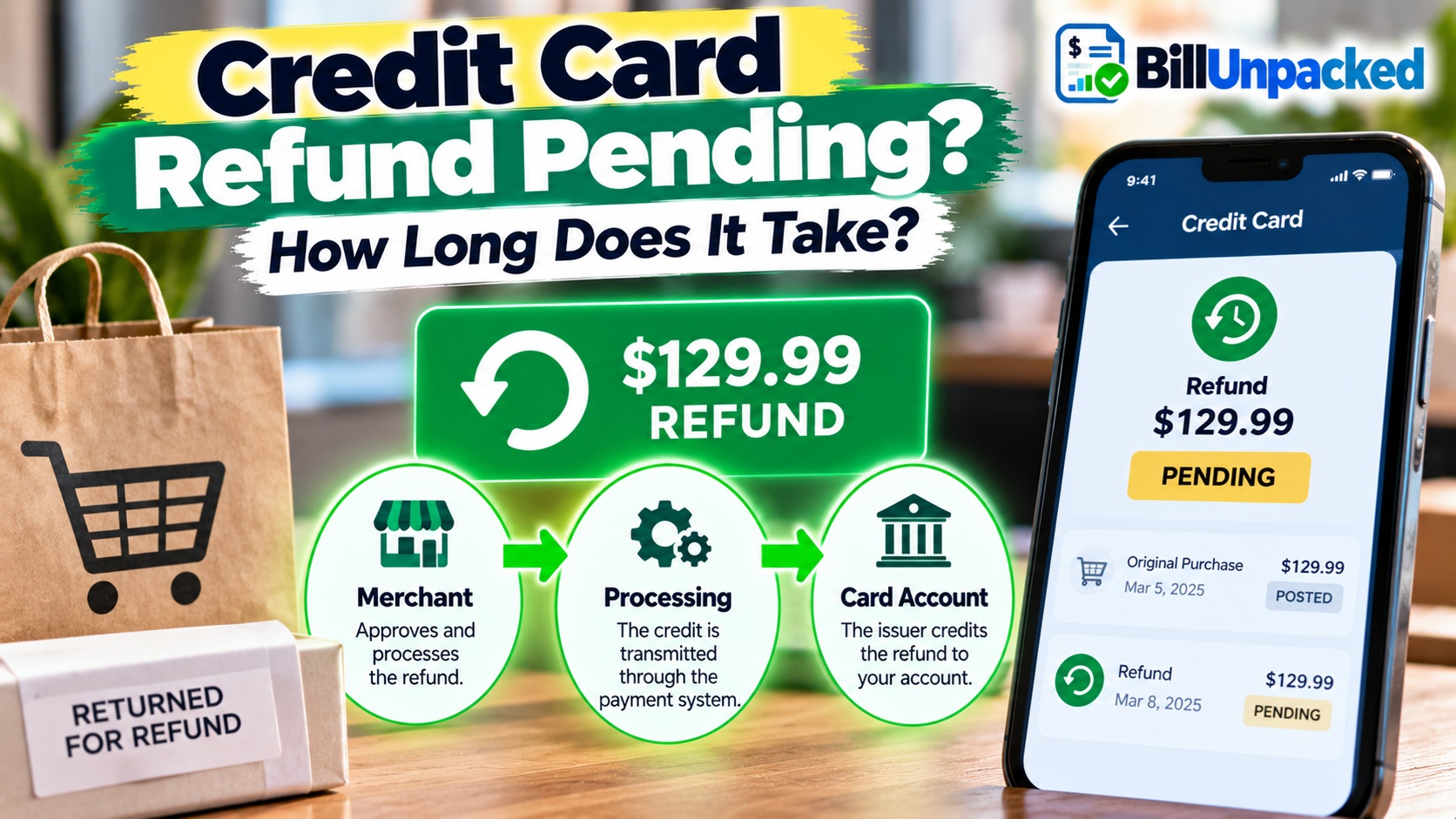
If your credit card refund is pending or not showing yet, first confirm that the merchant actually processed the refund. A refund normally travels from the merchant through the payment system to your card issuer before appearing as a credit on your account. The visible timing can vary, so keep the refund receipt or confirmation and monitor your account.
Why Isn’t My Credit Card Refund Showing Yet?
A merchant telling you that a refund was approved does not necessarily mean the credit will immediately appear in your online card activity.
The process can involve several stages:
- The merchant approves the return or refund.
- The merchant sends the credit through its payment-processing channel.
- The card issuer receives the credit information.
- The issuer credits the card account.
- Your online account or statement displays the transaction.
That distinction helps explain why a merchant can say “refund processed” while you do not yet see a visible credit.
What Does Federal Law Say About Refund Timing?
Regulation Z contains specific requirements for credit-card refunds involving a creditor other than the card issuer.
| Stage | Regulation Z Requirement |
|---|---|
| Merchant accepts return / forgives debt | Generally must transmit a credit statement to the card issuer within 7 business days. |
| Issuer receives credit statement | Generally must credit the consumer’s account within 3 business days. |
| Visible posting | The regulation’s official interpretation says the issuer does not necessarily have to visibly post the refund within those 3 business days if it credits the account effective within that period. |
Refund vs. Authorization Release: Are They the Same?
No. This is one of the most important distinctions.
Refund
A refund generally occurs after a transaction has been completed and the merchant sends money back as a credit to the card account.
Authorization Release or Reversal
If a transaction never fully completed, the merchant may instead release or reverse an authorization.
In that case, you may see the original pending transaction disappear rather than see a separate refund credit.
Posted purchase → refund credit
Pending authorization → may be released/reversed These are different payment-processing paths.
See: Reversed Credit Card Charge: What Does It Mean?
Credit Card Refund Status Checker
Use this tool to organize what you know about the refund. It does not predict an exact arrival date.
Where Might My Refund Be?
Enter the refund amount and select the situation that best matches your account.
Does a Refund Always Show as “Pending” First?
No.
Credit-card interfaces differ. A refund might appear as:
- Pending credit
- Refund
- Credit
- Merchant credit
- Returned purchase
- A posted negative amount
Some issuers may not display a distinct pending-refund stage at all.
So searching for the word “pending” is not enough. Review the transaction history and account balance as well.
What If the Merchant Says “Refunded” but I See Nothing?
Ask the merchant for specific information rather than another general assurance.
Ask the Merchant For:
- The exact refund amount
- The date the refund was processed
- Confirmation that it went back to the original card
- A refund receipt or confirmation
- Any available refund or transaction reference
Then check that you are looking at the correct credit-card account, particularly if the original card has since been replaced.
Should I Contact the Merchant or Card Issuer?
If you requested a normal refund for a purchase, the CFPB recommends first contacting the company that sold you the product or service and asking it to refund the money or undo the charge. :contentReference[oaicite:1]{index=1}
If the merchant confirms that the refund was actually issued but you cannot locate the credit, contact your card issuer and provide the merchant’s refund details.
What If the Merchant Refuses to Refund Me?
A delayed refund and a merchant refusing to provide a refund are different problems.
Whether you are entitled to a merchant refund can depend on the seller’s return policy, what was promised, the reason for the refund and applicable law.
For qualifying credit-card billing errors—for example, certain situations involving goods or services that were not delivered as agreed—the CFPB explains that federal billing-error protections may apply. :contentReference[oaicite:2]{index=2}
What If a Refund Creates a Negative Credit Card Balance?
A large refund can sometimes create a credit balance—for example, if you already paid your card balance before the refund arrived.
Example:
| Account Activity | Example |
|---|---|
| Card balance before refund | $50 |
| Merchant refund | -$150 |
| Resulting credit balance | -$100 |
Current Regulation Z says that when a credit balance greater than $1 is created, the issuer must credit it to the account. If you make a qualifying written request for a refund of the remaining credit balance, the issuer generally must refund it within seven business days.
Will a Refund Restore My Available Credit Immediately?
Not necessarily at the exact moment the merchant approves the refund.
The timing of available-credit changes can depend on when the issuer receives and credits the refund and on other account activity.
Check your issuer’s account information rather than assuming the merchant’s refund confirmation immediately restores the same amount of available credit.
What If I Already Paid the Credit Card Bill?
You can still receive a merchant refund after paying the card balance.
Depending on the rest of your account activity, the refund may reduce another balance or create a credit balance.
If a credit balance greater than $1 remains, Regulation Z provides specific rules for its treatment, including refund rights when you make a written request.
Refund vs. Chargeback: What’s the Difference?
| Merchant Refund | Card Dispute / Chargeback | |
|---|---|---|
| Who starts it? | Usually merchant | Cardholder raises problem with issuer |
| Purpose | Merchant returns purchase amount | Dispute process for a transaction problem |
| Same process? | No | No |
| Federal billing-error rules? | Refund rules may apply | May apply to qualifying billing errors |
The CFPB recommends asking the seller for a refund first in an ordinary product or service problem, while also explaining that consumers may have credit-card dispute or billing-error options when the seller does not resolve the problem. :contentReference[oaicite:3]{index=3}
Can a Refund Take Several Days to Appear?
Yes. Visible processing can take time.
For example, Chase currently tells consumers that a credit-card refund may show in the online account within a few days, but that the exact timeframe varies depending on the merchant and card issuer. That is an issuer example, not a universal deadline. :contentReference[oaicite:4]{index=4}
This is why the most useful evidence is the merchant’s actual refund confirmation combined with the transaction activity on your card account.
5-Minute Refund Checklist
Check These in Order
- Confirm the original purchase actually posted.
- Determine whether this is a refund or authorization release.
- Find the merchant’s refund confirmation.
- Verify the exact refund amount.
- Check the date the merchant says it processed the refund.
- Confirm which card received the refund.
- Review your full card transaction history.
- Check whether the refund created a credit balance.
- Contact the merchant if it has not actually transmitted the refund.
- Contact the issuer if the merchant confirms transmission but you cannot locate the credit.
- Preserve any applicable billing-error rights if the underlying purchase remains disputed.
Bottom Line
If your credit card refund is pending or missing, first determine whether you are actually waiting for a merchant refund or for a pending authorization to be released.
For a true refund, keep the merchant’s confirmation and monitor your card account. Federal rules establish requirements for transmitting and crediting qualifying refunds, but the moment a refund becomes visibly displayed in an app is not necessarily identical to its effective credit date.
If the merchant says the refund was transmitted and you still cannot locate it, contact your card issuer with the refund details.
Authoritative Sources
Consumer Financial Protection Bureau — Regulation Z §1026.12:
Prompt Notification of Returns and Crediting of Refunds
Consumer Financial Protection Bureau:
How Can I Get a Refund on a Credit Card Purchase?
Consumer Financial Protection Bureau:
How Do I Dispute a Credit Card Charge?
Consumer Financial Protection Bureau — Regulation Z §1026.11:
Treatment of Credit Balances