
Are Pending Transactions Included in Current Balance?
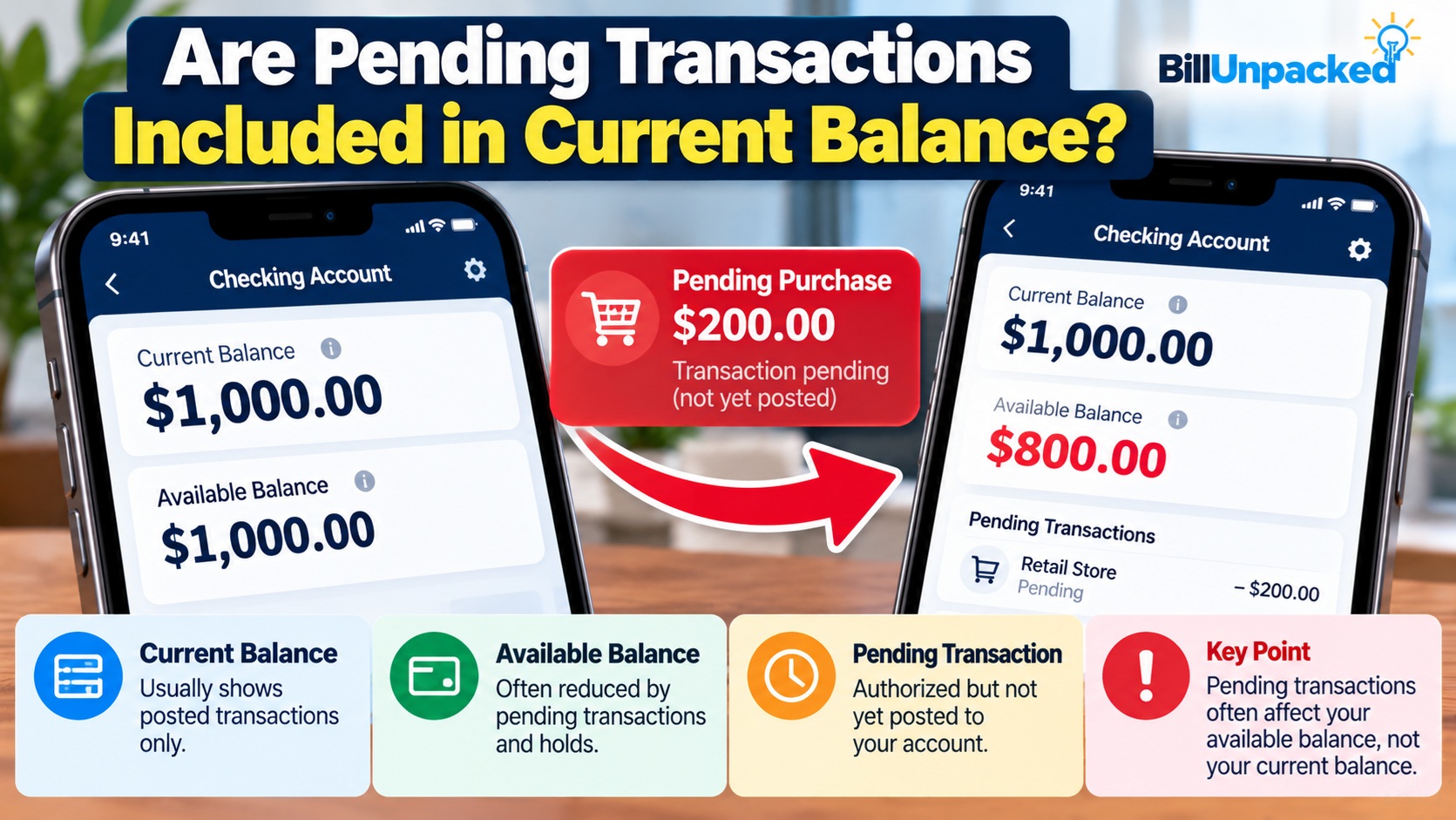
Usually, no. A pending debit-card transaction has been authorized but has not fully posted to your bank account yet. At many U.S. banks, it therefore may not yet reduce your current or posted balance, while it does reduce your available balance. That is why your current balance can look higher than the amount you can actually spend. Banks use different terminology and processing rules, so always check how your own bank defines current balance and available balance.
Current Balance vs. Available Balance
The easiest way to understand pending transactions is to separate two numbers commonly displayed in banking apps.
Generally reflects transactions that have already posted to the account. A pending debit-card purchase may not yet be deducted from this figure.
Represents funds currently available for use and commonly accounts for authorized pending debit-card purchases and certain holds.
Simple Example: $1,000 Balance With a $200 Pending Purchase
Current balance: $1,000
Available balance: $1,000
You make a $200 debit-card purchase
Transaction status: Pending
A bank might then display:
Current balance: $1,000
Available balance: $800
After the $200 transaction posts:
Current balance: $800
Available balance: $800*
*This simplified example assumes there are no other deposits, withdrawals, holds or transactions affecting the account.
This explains why someone can open a banking app, see $1,000 as the current balance, but only have $800 available to spend.
Why Doesn’t the Current Balance Include the Pending Transaction?
Because pending and posted are different stages of payment processing.
When you use a debit card, the merchant can request authorization from your bank. The bank may approve the transaction and place a hold on the money.
At this stage, the transaction can appear as pending.
The merchant still has to complete the transaction. Once the final transaction is received and processed by the bank, it becomes posted.
Posted: Completed and recorded against the account.
Do Pending Transactions Affect Available Balance?
They commonly do.
Capital One, for example, explains that pending debit-card transactions affect the available balance while they are waiting to post.
This is why the available balance can provide a more useful picture of what you can currently spend than simply looking at the current balance.
Why Are My Current and Available Balances Different?
Pending card purchases are one common reason, but they are not the only reason.
| Activity | Current Balance | Available Balance |
|---|---|---|
| Posted debit-card purchase | Normally reflected | Normally reflected |
| Pending debit-card purchase | May not yet be reflected | Commonly reduces it |
| Merchant authorization hold | May not change immediately | Can reduce available funds |
| Deposit hold | May appear in account activity | Some or all funds may not yet be available |
| Outstanding check | Generally not deducted until presented/posted | May not be reflected before the bank receives it |
What Happens When the Pending Transaction Posts?
Once processing is completed, the pending transaction normally changes to a posted transaction.
At that point, the final amount becomes part of the account’s posted transaction history and is reflected in the applicable balance.
The pending amount and final amount are not always identical.
Why Can a Pending Amount Change?
Some merchants initially authorize an estimated or temporary amount. The final charge can be different.
Common examples include:
- Restaurants: the initial authorization may not yet include the final tip.
- Hotels: an authorization may include an amount for incidentals.
- Rental cars: a temporary hold can exceed the expected rental charge.
- Gas stations: pay-at-the-pump transactions may initially create an authorization hold.
Capital One specifically identifies restaurants, gas stations and travel transactions as situations where a pending authorization can differ from the amount eventually posted.
Are Pending Credit Card Transactions Included in the Balance?
Credit cards require a slightly different explanation.
A pending credit-card purchase has not fully posted to the account yet. It will commonly reduce your available credit before it is added to the posted account balance.
Credit limit: $5,000
Posted balance: $1,000
Pending purchase: $300
The pending purchase may reduce the credit available to you even though the $300 has not yet been incorporated into the posted account balance.
Chase notes that the exact way pending transactions appear in a credit-card balance can vary by issuer.
Current Balance vs. Available Balance on a Credit Card
Don’t confuse a bank-account available balance with a credit card’s available credit.
With a checking account, available balance generally tells you how much money is currently available for use.
With a credit card, available credit generally tells you how much of your credit line remains available.
A pending purchase can reduce that available credit even before the transaction posts.
Should I Spend Based on Current Balance?
Be careful.
If your current balance is $2,000 but you have $700 of pending debit-card purchases, treating the entire $2,000 as spendable could give you an inaccurate picture of the funds available.
Can a Pending Transaction Disappear?
Yes.
A pending authorization can disappear if the merchant does not complete the transaction or if an authorization is canceled or voided.
Capital One explains that when this happens, the available balance can be restored and the transaction may never appear as a posted transaction.
However, don’t automatically assume that a purchase has been canceled just because the pending entry disappeared. The final transaction may still be submitted by the merchant depending on the circumstances.
How Long Do Pending Transactions Take?
There is no single time that applies to every transaction and every financial institution.
Capital One says its pending bank-account transactions can remain pending for up to five days. Chase says everyday pending credit-card transactions will likely process within approximately three to five business days.
Merchant type, authorization processing and the bank or card issuer can all affect timing.
Why Is My Available Balance Higher or Lower Than Expected?
Look at all recent activity rather than only the large balance displayed at the top of your banking app.
Check for:
- Pending debit-card purchases
- Recently posted transactions
- Deposit holds
- Merchant authorization holds
- Recently released holds
- Transfers
- Outstanding checks you have written
- Scheduled payments that may not yet have reached the bank
Some of these transactions may not be represented in the same way by every financial institution.
Does Available Balance Include Every Future Payment?
No.
Available balance should not be interpreted as a prediction of every payment that will hit your account.
For example, a check you wrote but that has not yet been presented to your bank may not have reduced the displayed balance.
Similarly, a future bill payment that has not yet been processed may need to be accounted for separately.
What If I Don’t Recognize a Pending Transaction?
First check whether the merchant is displaying a different billing name than the business name you recognize.
Also consider:
- A restaurant authorization before the tip is finalized
- A hotel or rental-car hold
- A gas-station authorization
- A purchase made by another authorized account/card user
If you still don’t recognize it, follow your bank or card issuer’s instructions for reporting suspicious activity.
For credit cards, many issuers require a pending charge to post before a standard transaction dispute can be opened, although suspected fraud should be reported according to the issuer’s security instructions.
Quick Answers
| Question | Answer |
|---|---|
| Are pending transactions included in current balance? | Often not yet. A pending debit-card transaction commonly affects available balance before it is reflected in the posted/current balance. |
| Do pending transactions reduce available balance? | Authorized pending debit-card transactions commonly do. |
| Which balance should I look at before spending? | Available balance is generally more useful, but also account for checks and other transactions the bank may not yet know about. |
| Can pending transactions disappear? | Yes. An authorization can be released without posting, although circumstances vary. |
| Can the pending amount change? | Yes. Restaurants, hotels, rental cars and gas stations are common examples. |
| Do pending credit-card purchases affect available credit? | They commonly reduce available credit before becoming part of the posted account balance. |
| Are current balance and available balance the same? | Not necessarily. Pending transactions and holds can create a difference between them. |
Bottom Line
So, are pending transactions included in current balance? In many banking systems, an authorized debit-card transaction that is still pending is not yet included in the posted/current balance. Instead, it commonly reduces the available balance.
Once the transaction posts, the current balance updates to reflect it.
Because terminology and balance calculations can vary among banks, credit unions and card issuers, check your institution’s definition when the distinction matters.
And when deciding what you can safely spend, remember that even an available balance may not account for checks or payments the bank has not yet received.
Authoritative Sources
Capital One — Pending Debit Card Transactions
How pending transactions affect available balance
American Express — Current vs. Available Balance
Explanation of current and available balances
Chase — Pending Credit Card Transactions
How pending credit-card transactions work
Last reviewed: October 5, 2026. Balance terminology and transaction-processing practices vary by financial institution. Check your bank or credit union’s account agreement for rules applying to your specific account.