
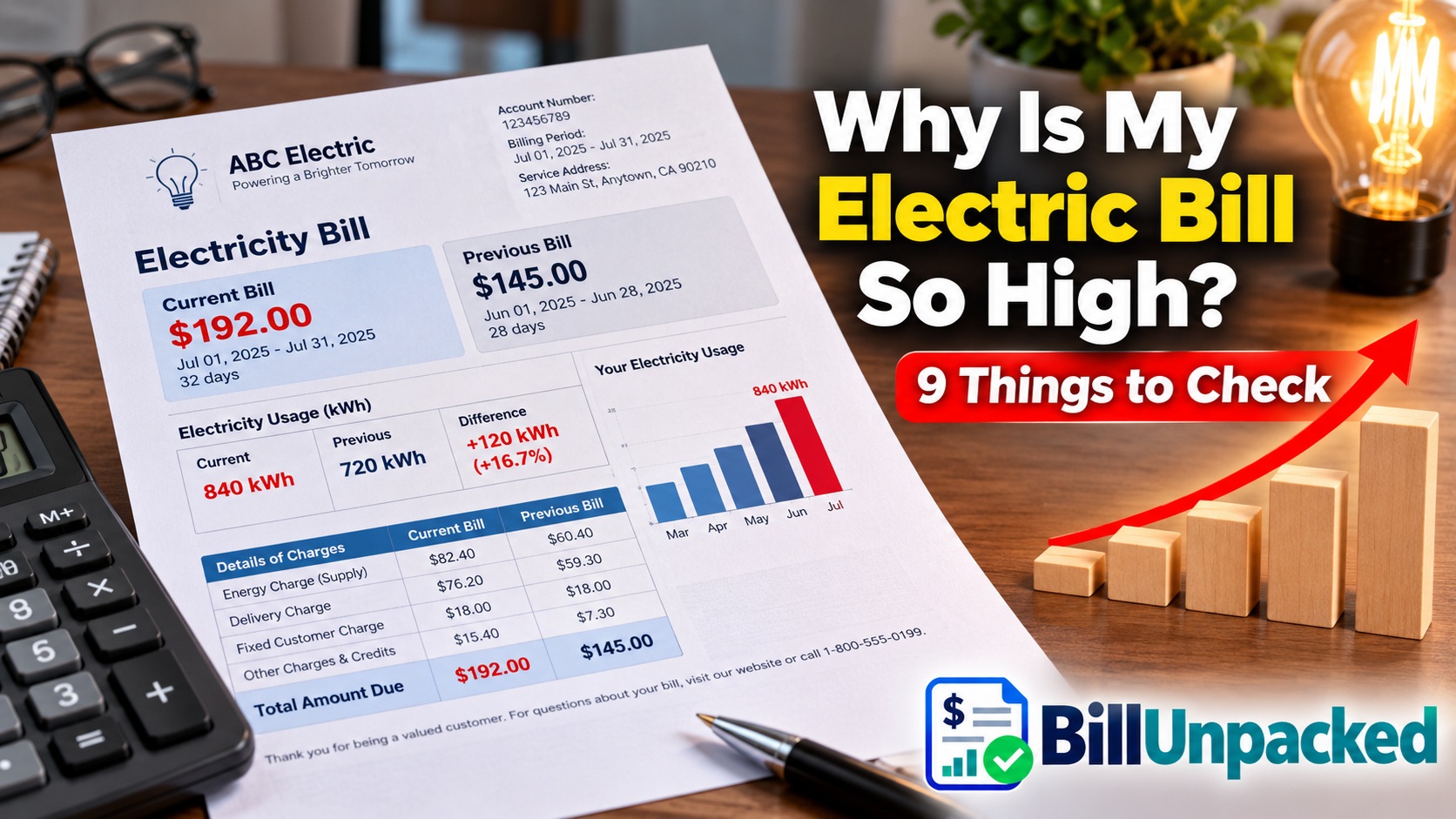
A surprisingly high electricity bill does not automatically mean something is wrong with your meter. The fastest way to investigate is to compare the numbers on your current bill with your previous bill instead of comparing only the amount due.
What Should I Check First on a High Electric Bill?
Start with electricity usage rather than the dollar amount. Electricity consumption is commonly measured in kilowatt-hours (kWh). A kilowatt-hour represents using 1,000 watts of electricity for one hour.
Find the total kWh shown on your current bill and compare it with the previous billing period. If available, also compare it with the same month from the previous year.
| Check | What to Compare | What It May Tell You |
|---|---|---|
| Usage | Current kWh vs. previous kWh | Whether electricity consumption changed |
| Billing period | Number of days on each bill | Whether one bill covers more days |
| Rate | Rate information on both bills | Whether the price applied to usage changed |
| Charges | Individual line items | Whether fees or other charges changed |
1. Did You Use More Electricity?
A higher bill often accompanies higher electricity consumption. Check the kWh figure printed on the bill or displayed in your utility’s online account.
For example, suppose your previous bill showed 720 kWh and your new bill shows 940 kWh. That is an increase of 220 kWh, or about 30.6%.
The next question is not simply “Why did my bill increase?” but rather “What caused my electricity usage to increase?”
Possible changes to investigate include:
- More air-conditioning or electric heating use
- More people spending time at home
- A new refrigerator, freezer or other appliance
- Electric vehicle charging
- Portable electric heaters
- Pool pumps or other outdoor equipment
- Changes in thermostat settings
- Equipment operating longer than expected
2. Was This Billing Period Longer?
Do not assume two monthly bills cover exactly the same number of days.
For example, comparing a 28-day billing period with a 33-day period can make the second bill appear significantly higher even when average daily usage changed much less.
A useful calculation is:
If one bill contains 900 kWh over 30 days, average consumption was 30 kWh per day. Comparing daily usage can provide a fairer picture when billing periods have different lengths.
3. Did Your Electricity Rate Change?
If your electricity usage remained fairly similar, examine the rate information and charges on the bill.
Electricity bills and rate structures are not identical throughout the United States. The terminology used by your utility may also differ. Compare your current bill directly with your previous bill and use your utility’s official rate information when you need an explanation of a particular charge.
A bill can therefore increase even when household consumption does not rise by the same percentage.
4. Did Delivery, Supply or Other Charges Change?
Do not stop after finding the kWh number. Compare the bill line by line.
Depending on the utility and rate structure, a bill may contain several components. Look for any line item whose dollar amount or rate changed noticeably.
Because electricity regulation and billing structures vary by location, BillUnpacked does not assume that every U.S. customer will see the same charge names. When a charge is unclear, check the explanation provided by your utility or appropriate state utility regulator.
If your electricity usage barely changed but the amount due increased, see our guide to why an electric bill can be high even when usage is the same.
5. Could Weather Be Increasing Your Usage?
Heating and cooling can represent a major part of household energy consumption. The U.S. Department of Energy recommends measures such as appropriate thermostat settings, air sealing, insulation and maintaining heating and cooling equipment as ways to improve household energy efficiency.
This means a large weather change can be relevant when investigating an unusually high bill, especially in homes using electricity for air conditioning or heating.
Compare the bill with a similar season when possible. Comparing an unusually hot summer month with a mild spring month may not provide a useful baseline.
6. Did Something Change Inside Your Home?
Think about what changed during the billing period rather than only what is plugged in today.
Ask yourself:
- Did anyone start working from home?
- Were guests staying for an extended period?
- Did you buy a new appliance?
- Did you begin charging an electric vehicle at home?
- Did you use portable heating or cooling equipment?
- Did an appliance begin running more frequently?
Even several relatively small changes can combine to produce a noticeable difference in total consumption.
7. Was the Meter Reading Estimated?
Check the bill to see how the meter reading is described. If the utility distinguishes between actual and estimated readings, determine which type was used for the billing period.
Do not assume that an estimated reading automatically means the bill is incorrect. Instead, use it as a reason to compare the reading information and, if necessary, ask the utility how the billed usage was determined.
8. Compare Daily Usage, Not Just Monthly Usage
This is especially useful when the number of billing days changed.
| Previous Bill | Current Bill | |
|---|---|---|
| Usage | 750 kWh | 870 kWh |
| Billing days | 28 | 32 |
| Average/day | 26.8 kWh | 27.2 kWh |
The monthly totals in this example differ by 120 kWh, but daily consumption is much closer. The longer billing period explains much of the difference.
9. When Should You Contact Your Electric Company?
Contact your utility when you cannot reconcile the bill after comparing usage, billing dates, rate information and individual charges.
Useful questions include:
- What meter readings were used for this bill?
- Was the reading actual or estimated?
- How many days are included in this billing period?
- Did the rate applied to my account change?
- Can you explain this specific line item?
- How does my daily usage compare with the previous period?
Having both bills in front of you makes the conversation much more useful.
Electric Bill Increase Calculator
Use this calculator to compare both the dollar amount and electricity consumption. Your entries are calculated in your browser and are not sent anywhere by this calculator.
Compare Your Electric Bills
Enter information from your previous and current bills.
How Do I Tell Whether Usage or Price Is the Bigger Problem?
The calculator above gives you a useful starting point.
If your bill increased by 35% while kWh consumption increased by only 5%, increased usage alone does not explain the entire dollar increase. Examine billing days, rates and individual charges more closely.
On the other hand, if the bill increased 25% and consumption increased approximately 25%, higher usage deserves your attention first.
Quick Diagnosis
- Bill ↑ and kWh ↑ substantially: investigate what increased electricity consumption.
- Bill ↑ but kWh is similar: investigate rates, billing days and other charges.
- kWh ↑ but daily kWh is similar: check whether the billing period was longer.
- Nothing explains the increase: contact the utility and ask for a bill and meter-reading explanation.
Can I Reduce a High Electric Bill?
Once you know what changed, you can target the cause rather than trying random energy-saving tips.
If heating or cooling is responsible for much of the increase, the U.S. Department of Energy recommends considering areas such as thermostat settings, insulation, air sealing and HVAC maintenance when improving household energy efficiency.
If the increase comes primarily from a rate or charge rather than consumption, reducing a few appliance loads may not address the main reason your dollar bill changed. Understanding the bill should come first.
Be cautious if someone unexpectedly claims to be your utility and demands immediate payment. The Federal Trade Commission advises consumers to contact the utility themselves using a number they know is legitimate, such as the number on their bill or the company’s legitimate website. Be especially suspicious of demands for payment by gift card, cryptocurrency or money transfer.
Bottom Line: Why Did My Electric Bill Go Up?
Start with four numbers: kWh used, billing days, electricity rate information and the individual charges on the bill.
Those comparisons can help separate an increase caused mainly by household consumption from one associated with billing-period differences, rates or other charges.
If the numbers still do not explain the increase, contact your utility and ask it to explain the meter reading and individual charges. That is more reliable than guessing that a particular appliance, meter problem or rate change caused the bill.
Authoritative Sources & Further Reading
U.S. Energy Information Administration (EIA):
How electricity is measured
U.S. Department of Energy:
Energy efficiency guidance
Federal Trade Commission:
How to recognize utility impersonation scams