If your electric bill increased but your electricity usage looks almost the same, don’t immediately assume something is wrong with your meter. Compare the rate, billing period, individual charges, credits and your actual kWh usage before deciding what caused the increase.
Can My Electric Bill Increase Even If Usage Is the Same?
Yes. The amount of electricity you use is only one part of understanding the final amount on an electric bill.
The U.S. Energy Information Administration explains that electricity rates can include charges for the electricity itself as well as delivery and other services or charges. Electricity pricing also varies by location and regulatory structure.
That means two bills with similar kWh totals do not necessarily have to have identical dollar totals.
1. First, Make Sure Your Usage Really Is the Same
Start with the kWh figure. A kilowatt-hour (kWh) is a measure of electricity used over time and is commonly used by electric utilities to measure customer consumption.
For example:
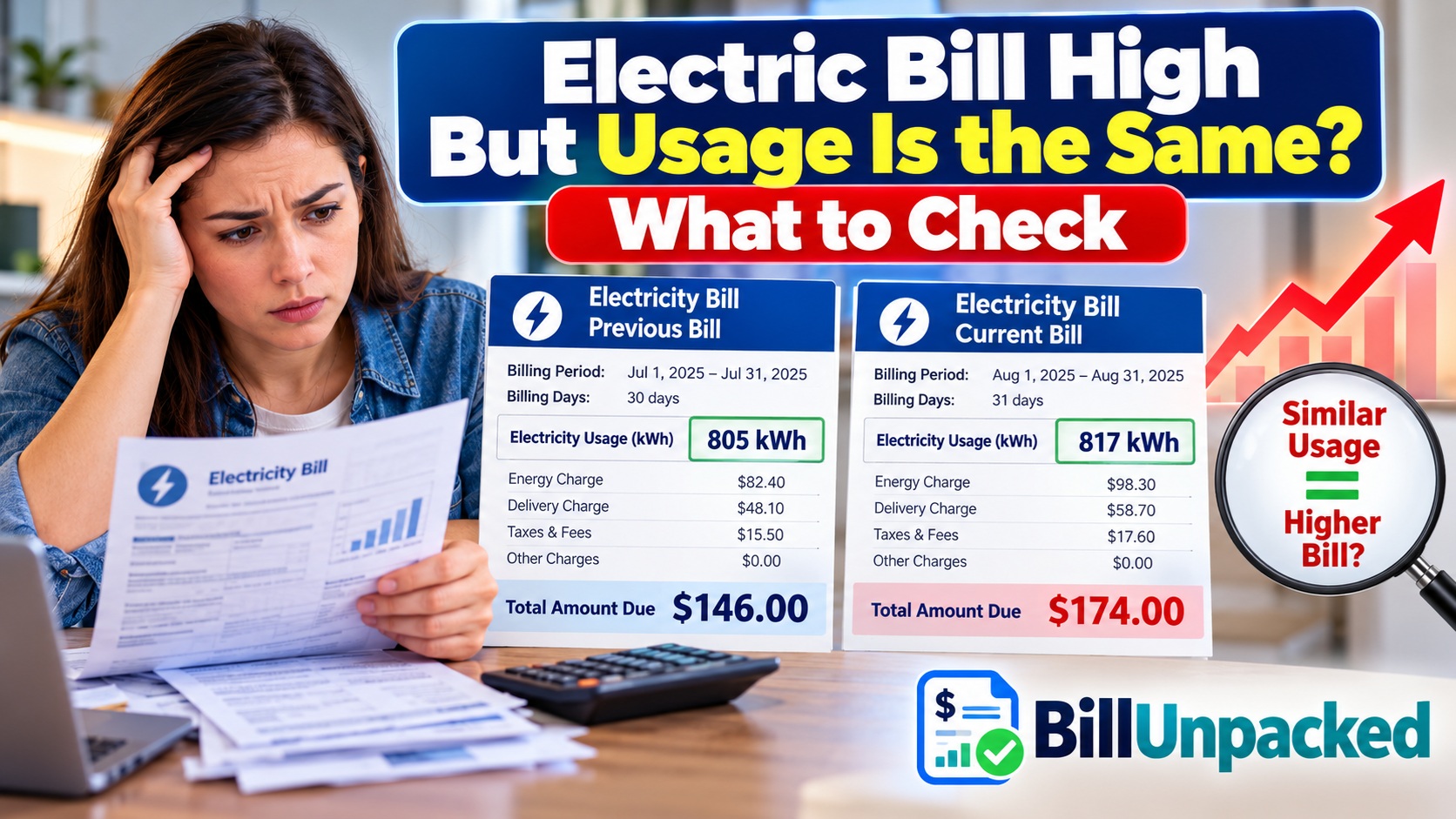
| Previous Bill | Current Bill | |
|---|---|---|
| Electricity usage | 805 kWh | 817 kWh |
| Amount | $146 | $174 |
Usage increased by only 12 kWh in this example, while the dollar bill increased much more noticeably. That is a reason to investigate factors beyond consumption.
If your kWh actually increased substantially, start with our broader guide: Why Is My Electric Bill So High? 9 Things to Check .
2. Did the Electricity Rate Change?
Compare the rate information shown on both bills.
Electricity prices vary across the United States. The EIA explains that factors influencing electricity prices include fuel costs, power plant costs, transmission and distribution expenses, weather and regulations.
Your individual utility rate is more important than a national average when diagnosing your own bill, so use the rate printed on your bill and your utility’s official rate information.
3. Did Your Billing Period Change?
A similar monthly kWh number can hide differences in the number of billing days.
For a better comparison, calculate:
For example, 810 kWh across 30 days equals 27 kWh per day. If another billing period contains 815 kWh across 28 days, average daily usage is approximately 29.1 kWh.
Checking billing dates also helps you avoid comparing periods that are not equivalent.
4. Did Delivery or Other Charges Increase?
Read the bill line by line. Do not assume every charge is directly proportional to kWh usage.
EIA distinguishes between an overall retail electricity price and the individual rates applied to services such as electricity supply, delivery and other services or charges.
The exact terminology varies by utility and location, so your bill might not use those exact labels.
Look for differences in items such as:
- Electricity or energy supply charges
- Delivery or distribution charges
- Fixed customer charges
- Taxes or government-mandated charges
- Adjustments
- Credits
- Other utility-specific line items
If you do not understand a particular charge, use the utility’s official explanation rather than assuming what the charge represents.
5. Did a Credit or Discount Disappear?
Sometimes the important difference is not a new charge but something that appeared on the previous bill and is no longer present.
Compare the credits and adjustments sections carefully. A previous credit can make an older bill unusually low, which makes the next normal bill appear to be a large increase.
If you participate in a utility discount, assistance, budget billing, solar credit or other program, check the account details and contact the provider if an expected credit is missing.
6. Are You on a Time-of-Use Rate?
Some utilities offer or use rate structures where the price can depend on when electricity is consumed.
EIA notes that some utilities offer time-of-day pricing designed partly to encourage customers to shift electricity consumption away from periods of high demand.
If your plan works this way, similar total kWh consumption does not necessarily mean the same bill if the timing of that consumption changed.
Check your utility’s official rate plan to see whether your account has peak, off-peak or other time-based pricing.
7. Are You Comparing the Correct Amounts?
Make sure you are comparing the actual charges for the current billing period rather than a total that includes something else.
For example, depending on the bill, the total amount due could potentially reflect a previous balance, payment, credit or adjustment.
The exact layout differs among utilities, so identify the section that represents the current billing-period charges before comparing the two statements.
Electric Bill Same-Usage Comparison Calculator
Enter the dollar amount and kWh from two bills. This calculator helps you see whether the percentage change in your bill is much larger than the percentage change in electricity usage.
Bill vs. Usage Checker
Your entries are calculated in your browser.
What If My Bill Increased Much More Than My Usage?
That does not automatically prove that your utility made an error.
Instead, it tells you that the change in kWh alone does not mathematically explain the entire percentage change in the dollar amount.
Check These Next
- Rate information on both bills
- Number of billing days
- Delivery and other charges
- Fixed charges
- Credits or discounts
- Previous balances or adjustments
- Time-of-use rate periods, if applicable
When Should I Contact My Electric Utility?
Contact the utility if you still cannot explain the difference after comparing the two statements.
Have both bills ready and ask specific questions:
- Was my rate or rate plan changed?
- Why did this particular charge increase?
- Was a credit removed or changed?
- Are these bills based on actual or estimated readings?
- Does the amount due include a previous balance or adjustment?
- How many days are included in each billing period?
Specific questions are more useful than simply asking why the bill is high.
If someone unexpectedly contacts you claiming your electricity will be disconnected unless you pay immediately, do not use the phone number or payment instructions supplied by the caller or message. Contact your utility yourself using the number on your bill or its legitimate website.
Bottom Line
When your electric bill is high but usage is about the same, compare more than kWh.
Check the rate, billing dates, individual charges, credits, adjustments and any applicable time-based rate structure. If the dollar increase still cannot be explained, ask your utility to walk through the two bills with you.
If you discover that your electricity usage actually increased significantly, continue with our guide: Why Is My Electric Bill So High? 9 Things to Check .
Authoritative Sources
U.S. Energy Information Administration:
Electricity prices and factors affecting prices
U.S. Energy Information Administration:
How electricity is measured
Federal Trade Commission:
Utility company impersonation scams
1 thought on “Electric Bill High but Usage Is the Same? What to Check”
Comments are closed.