
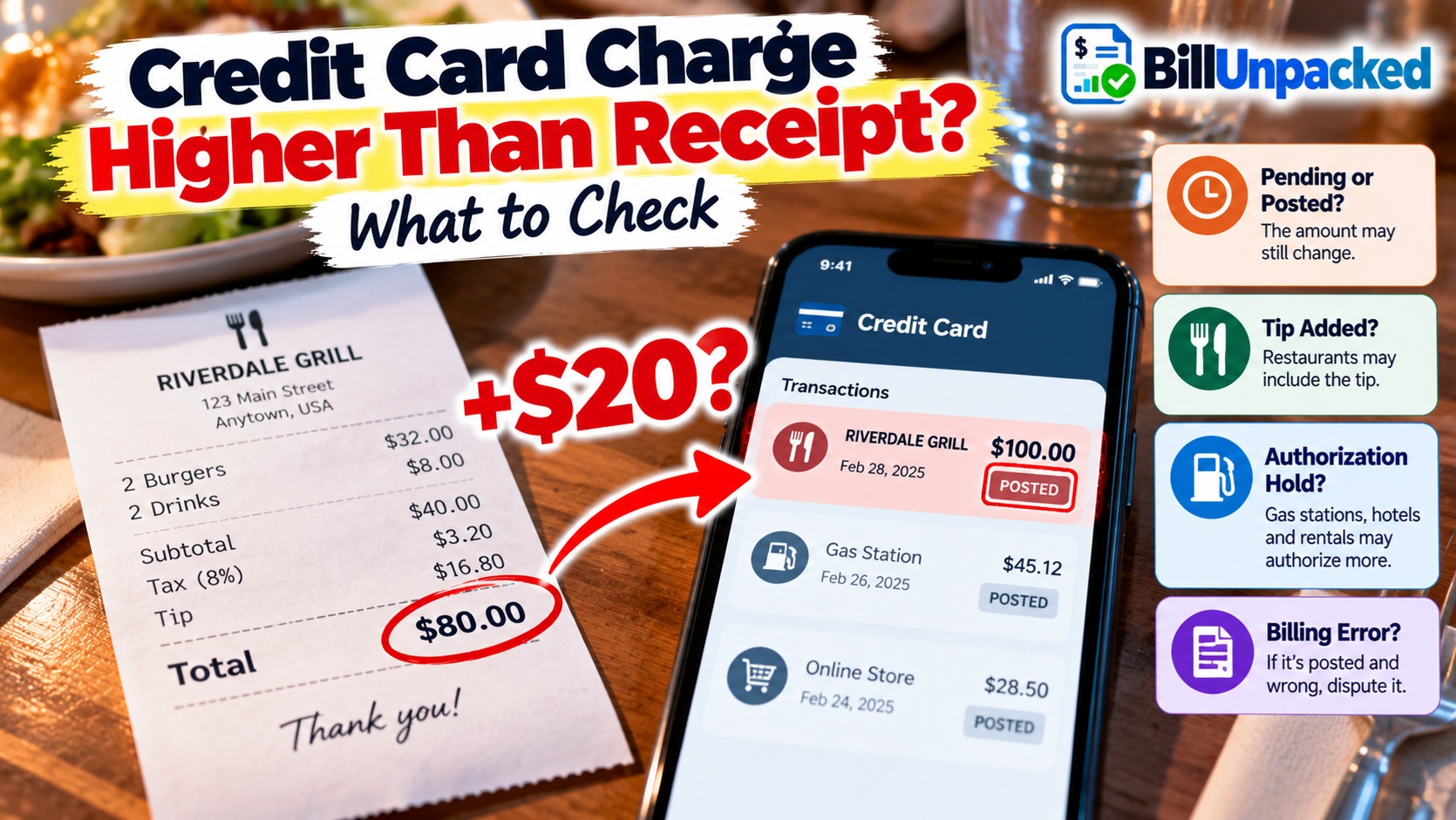
If your credit card charge is higher than the receipt, first check whether the card transaction is still pending or already posted. A pending authorization can differ from the eventual final charge, especially at restaurants, gas stations, hotels and rental-car businesses. If the higher amount has posted and does not match what you agreed to pay, save the receipt and investigate the discrepancy promptly.
First Check: Is the Charge Pending or Posted?
This is the most important first step.
A pending transaction has been authorized but has not necessarily completed processing.
The final posted amount can sometimes be different from the initial authorization.
For example, restaurants may initially authorize the meal amount before a tip is included. Gas stations, hotels and rental-car businesses can also use authorization amounts that differ from the final purchase.
| Status | What It Means | What to Check |
|---|---|---|
| Pending | Authorized but not yet fully processed | Wait for the final amount while monitoring the transaction |
| Posted | Transaction has completed processing on the account | Compare with the final receipt or amount you authorized |
| Reversed/Released | An authorization may have been removed | Check whether a separate final charge appears |
Why Can a Credit Card Charge Be Higher Than the Receipt?
It May Be a Temporary Authorization Hold
Some merchants authorize an estimated amount before they know the final purchase total.
This is particularly common in situations where the final amount is not known at the moment the card is first presented.
If the higher amount is still pending, check whether it changes when the transaction posts.
Learn more: What Is a Temporary Charge on a Credit Card?
A Restaurant Tip May Have Been Added
A restaurant transaction can initially appear for the pre-tip amount and later post for the total that includes the tip.
For example:
- Meal: $50
- Tip: $10
- Final authorized total: $60
A $60 posted transaction is therefore not necessarily an overcharge merely because the earlier restaurant subtotal was $50.
Compare the card charge with the final signed or electronic total, not just the pre-tip subtotal.
A Gas Station May Have Used a Pump Authorization
When you insert or tap your card before pumping fuel, the station does not yet know the final purchase amount.
A temporary authorization can therefore differ from the actual fuel receipt.
The key question is whether the higher amount is pending or posted.
A Hotel May Have Authorized Incidentals
Hotels may authorize more than the room price to cover possible incidental charges.
The authorization can affect available credit while it remains pending.
After checkout, compare the eventual posted transaction with your final hotel folio—not simply the earlier reservation price.
A Rental-Car Hold May Be Higher Than the Rental Estimate
Rental-car businesses can also authorize an estimated amount that is different from the final rental charge.
Compare the eventual posted amount with your final rental agreement and receipt.
The Merchant May Have Added a Disclosed Charge
Compare the final receipt carefully for legitimate additions such as:
- Tip
- Tax
- Shipping
- Service charges
- Additional products or services you agreed to
The important comparison is between the posted transaction and the final amount you actually agreed to pay.
The Merchant May Have Entered the Wrong Amount
Mistakes happen.
The FTC specifically identifies a credit-card transaction with the wrong amount as an example of a billing error that can be disputed under federal credit-card billing protections.
Keep your receipt because it can help document what you agreed to pay.
You May Be Looking at Two Different Transactions
Sometimes an old authorization and a newer posted charge can appear simultaneously.
That may look like you were charged extra even though one entry is still pending.
If both transactions eventually post, investigate whether you were actually charged twice.
See: Duplicate Credit Card Charge? What to Do
Receipt vs. Credit Card Charge Calculator
Enter the amount on your final receipt and the amount showing on your credit card. The calculator shows the dollar and percentage difference.
How Much Higher Is the Card Charge?
Use the final receipt total, including any tip or other amount you authorized.
What If the Higher Amount Is Still Pending?
A pending amount is not necessarily the final amount.
One issuer example illustrates this distinction: Capital One says pending credit-card transactions are authorized but not yet fully processed and specifically identifies restaurants, gas stations, hotels and rental agencies as situations where the pending and final amounts can differ.
So if you recognize the merchant and the transaction is pending, monitor it for the final posted amount.
What If the Wrong Amount Has Already Posted?
If the transaction is posted and is higher than the amount you authorized, keep the evidence showing the discrepancy.
Useful records include:
- Final receipt
- Order confirmation
- Hotel folio
- Rental agreement
- Merchant emails or messages
- Screenshot of the posted transaction
The FTC advises consumers to keep receipts because transaction details can help correct inaccurate charges.
Should I Contact the Merchant First?
For a recognized merchant where the amount appears incorrect, contacting the merchant can sometimes resolve a simple mistake quickly.
Ask the merchant to explain the final amount and correct it if necessary.
But do not let merchant discussions cause you to miss your credit-card billing-error deadline.
Can the Wrong Amount Be a Billing Error?
Yes.
The FTC says billing errors can include purchases with the wrong amount, wrong date or a mathematical error.
The federal Fair Credit Billing Act provides a process for disputing qualifying billing errors on credit-card and other revolving-credit accounts.
The CFPB recommends calling or using the issuer’s dispute process promptly and also following up with the written notice required to protect federal billing-error rights.
What Happens After I Send a Billing-Error Notice?
According to the CFPB, after receiving a qualifying written notice, the card company generally has 30 days to acknowledge it unless the required resolution procedures are completed within that period. The investigation generally must then be completed within two billing cycles. :contentReference[oaicite:1]{index=1}
While the billing-error investigation is underway, CFPB says you remain responsible for paying the correct, undisputed charges on time. :contentReference[oaicite:2]{index=2}
What If I Don’t Recognize the Merchant at All?
That is different from recognizing a purchase but disagreeing with the amount.
If you did not authorize the transaction, contact the card issuer promptly using the official number on your card, statement or issuer website.
Do not assume an unfamiliar transaction is harmless simply because the amount is pending.
What If I See the Correct Charge Plus Another Charge?
Check whether the second entry is:
- A pending authorization
- A released/reversed authorization
- A separate legitimate transaction
- A second posted charge
If the same purchase appears twice as two posted transactions, see our: Duplicate Credit Card Charge Guide.
5-Minute Checklist
Check These in Order
- Confirm the merchant name.
- Check whether the transaction is pending or posted.
- Find the final receipt.
- Compare the exact totals.
- Include any tip you authorized.
- Check taxes and disclosed additional charges.
- Look for a hotel, gas-station or rental authorization hold.
- Check whether another related transaction is pending.
- Save receipts and transaction screenshots.
- Contact the merchant about a recognized incorrect posted amount.
- Contact your card issuer promptly if the problem is unresolved or unauthorized.
- Do not miss the applicable billing-error deadline.
Bottom Line
If your credit card charge is higher than your receipt, first determine whether you are comparing a temporary authorization with a final receipt or a genuinely incorrect posted transaction.
A pending amount can legitimately differ from the final transaction in certain situations. But if the transaction has posted for more than you authorized, keep the receipt, contact the merchant and card issuer promptly, and preserve your federal billing-error rights.
Authoritative Sources
Consumer Financial Protection Bureau:
How to Fix Mistakes in Your Credit Card Bill
Consumer Financial Protection Bureau:
How Do I Dispute a Charge on My Credit Card Bill?
Federal Trade Commission:
Using Credit Cards and Disputing Charges
Capital One:
Understanding Pending Credit Card Transactions