OPM FEHB & PSHB 2027 Changes: Premiums and Open Season
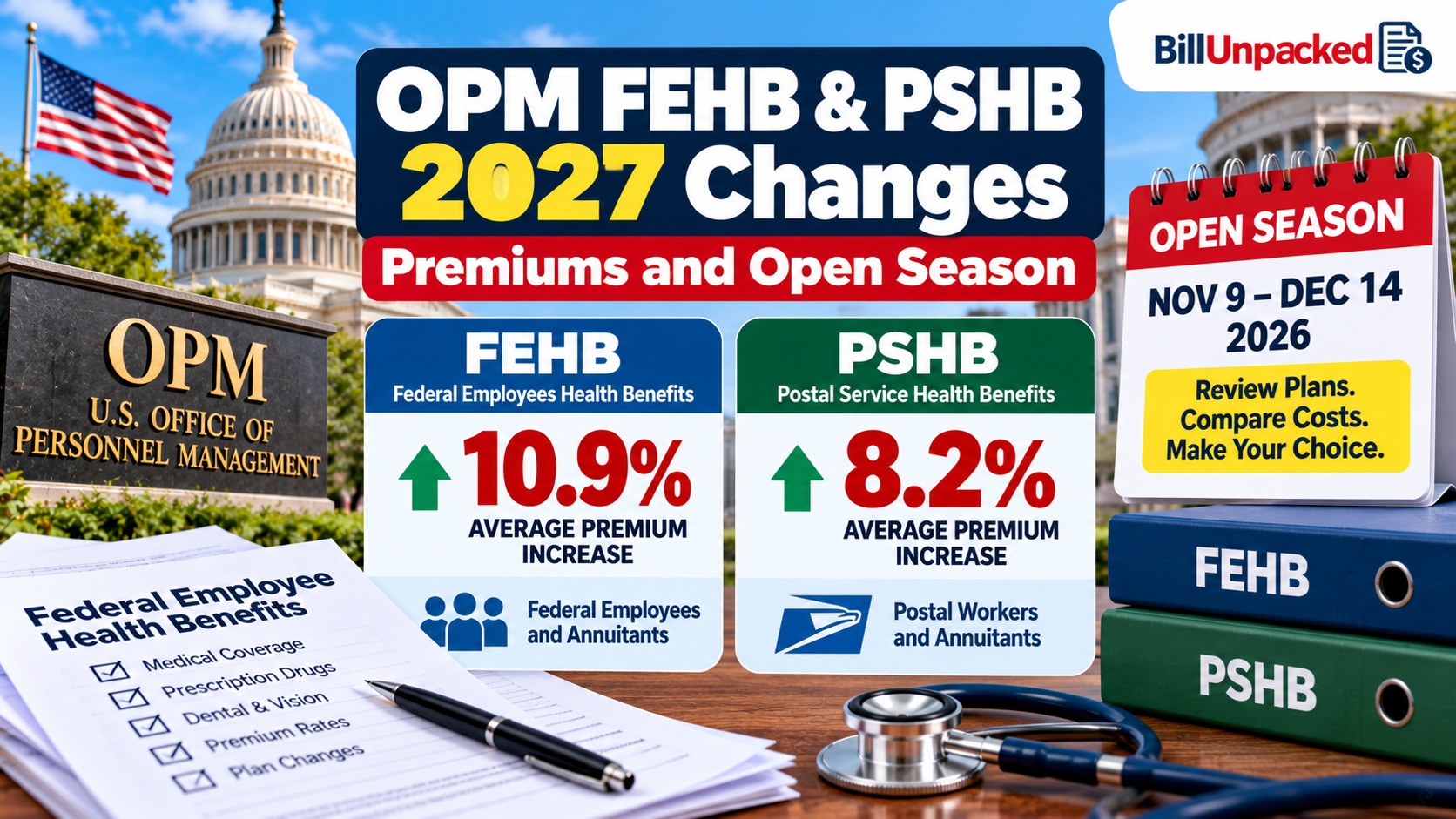
Federal employees, postal workers, and retirees will see important health insurance changes in 2027. The Office of Personnel Management (OPM) has announced an average 10.9% increase in the enrollee share of Federal Employees Health Benefits (FEHB) premiums and an 8.2% increase for Postal Service Health Benefits (PSHB). The 2026 Federal Benefits Open Season runs from November 9 through December 14, giving eligible members time to compare plans and make changes for 2027.
Quick Answer: OPM FEHB and PSHB Changes for 2027
FEHB premiums will increase by 10.9% on average and PSHB premiums by 8.2% on average in 2027, according to OPM’s announced rates. Your actual premium may rise more, rise less, stay unchanged, or decrease depending on your specific plan.
- FEHB average increase: 10.9% for the enrollee share.
- PSHB average increase: 8.2% for the enrollee share.
- Dental average increase: 1.0%.
- Vision average increase: 1.6%.
- Open Season: November 9–December 14, 2026.
- Plan year: 2027.
- Important: Review your plan’s premium, network, prescription coverage, and deductible before deciding whether to switch.
What Are the Biggest OPM Health Insurance Changes in 2027?
OPM released information about the 2027 health benefits plan year ahead of the annual enrollment period.
The changes affect federal employees, eligible annuitants, postal workers, and postal annuitants, although the rules and enrollment systems vary by program.
| Program | 2027 update | What it means |
|---|---|---|
| FEHB | 10.9% average enrollee premium increase | Many federal employees and annuitants will pay more for coverage. |
| PSHB | 8.2% average enrollee premium increase | Postal employees and eligible annuitants should review plan-specific rates. |
| FEDVIP dental | 1.0% average increase | Dental premiums generally change less than health premiums. |
| FEDVIP vision | 1.6% average increase | Vision premium changes depend on the selected plan. |
| FSAFEDS | New optional FSA debit card | Eligible employees can select a card for qualified expenses. |
| Open Season | November 9–December 14, 2026 | Eligible participants can review and change coverage. |
These are average changes across programs. The exact amount you pay depends on the insurance carrier, plan option, enrollment type, and applicable government contribution.
2027 FEHB Premium Increase: How Much More Will Federal Employees Pay?
The 2027 average increase in the enrollee share of FEHB premiums is 10.9%, compared with an average increase of 12.3% for 2026.
Although the rate of growth is lower than in 2026, a double-digit increase can still significantly affect household budgets.
Example: FEHB Premium Increase
Suppose you currently pay $250 every two weeks for FEHB coverage.
Current biweekly premium: $250.00
Illustrative 10.9% increase: $27.25
Illustrative new biweekly premium: $277.25
Illustrative annual increase over 26 deductions: $708.50
This example applies the program-wide average to a hypothetical premium. It is not a quote for any specific FEHB plan.
2027 PSHB Premium Increase: What Postal Workers Should Know
The Postal Service Health Benefits Program is the separate health insurance program for eligible Postal Service employees, annuitants, and family members.
OPM reports an average 8.2% increase in the enrollee share of PSHB premiums for 2027, compared with an 11.3% increase in 2026.
Postal employees should review the premium for their exact PSHB plan rather than using the FEHB average.
Example: PSHB Premium Increase
If your current PSHB premium is $200 per biweekly deduction, an illustrative 8.2% increase would produce:
- Current premium: $200.00.
- Increase: $16.40.
- Illustrative new premium: $216.40.
- Illustrative annual increase over 26 deductions: $426.40.
Check the official OPM PSHB plan information for your actual 2027 amount.
FEHB vs. PSHB: What Is the Difference?
| Feature | FEHB | PSHB |
|---|---|---|
| Full name | Federal Employees Health Benefits | Postal Service Health Benefits |
| Who it primarily serves | Eligible federal employees and annuitants | Eligible Postal Service employees and annuitants |
| 2027 average enrollee premium increase | 10.9% | 8.2% |
| 2027 participating carriers | 45 | 17 |
| 2027 plan options | 118 | 65 |
| Medicare Part B considerations | Depend on individual circumstances and plan rules | Additional Medicare Part B enrollment requirements apply to certain postal annuitants and family members, with exceptions |
OPM administers both programs, but eligibility, enrollment processes, and some coordination requirements differ.
When Is the 2027 FEHB and PSHB Open Season?
The official 2026 Federal Benefits Open Season runs from Monday, November 9, through Monday, December 14, 2026.
| Event | Date |
|---|---|
| OPM releases 2027 premiums | September 30, 2026 |
| Federal Benefits Open Season begins | November 9, 2026 |
| Open Season ends | December 14, 2026 |
| 2027 PSHB enrollment changes | Generally January 1, 2027 |
| 2027 FEHB employee changes | Generally the first applicable pay period beginning in January 2027 |
Effective dates can differ by enrollment category. Federal annuitants should follow OPM’s specific retirement enrollment instructions rather than assuming employee effective dates apply to them.
Do not wait until December 14 to check whether your current plan is leaving the program, changing its service area, or substantially modifying its benefits. Review the plan information early enough to make an informed decision.
What Happens If You Do Nothing During Open Season?
OPM states that existing FEHB, PSHB, and FEDVIP coverage generally continues into 2027 if you make no changes.
However, automatic continuation does not mean your premiums, benefits, doctors, or prescription coverage will stay the same.
Plans may also leave the program or change service areas. Members affected by these changes should carefully follow OPM’s notices and instructions.
Unlike health insurance coverage, FSAFEDS elections do not automatically renew. Eligible participants who want to contribute in 2027 must make a new election during Open Season.
Which FEHB and PSHB Plans Are Changing in 2027?
OPM has published plan-year information, including premium rates and significant plan changes.
Some FEHB plan options are discontinuing, and others are changing benefits or service areas.
Before deciding to keep your existing plan, review:
- Whether the plan is offered in your ZIP code for 2027.
- The exact enrollee premium for Self Only, Self Plus One, or Self and Family coverage.
- Changes to deductibles and out-of-pocket maximums.
- Prescription drug formularies and pharmacy rules.
- Whether your doctors and hospitals remain in network.
- Any changes to prior authorization or specialty drug coverage.
Use OPM’s official FEHB Plan Information and Open Season Resources.
What Are the 2027 FEHB Government Contributions?
The federal government contributes toward eligible FEHB premiums under statutory formulas.
OPM has published the following 2027 biweekly maximum government contribution figures based on 72% of the program-wide weighted average:
| Enrollment type | Maximum biweekly government contribution | Maximum monthly contribution |
|---|---|---|
| Self Only | $352.04 | $762.75 |
| Self Plus One | $767.53 | $1,662.98 |
| Self and Family | $843.82 | $1,828.28 |
These figures are not the amounts every enrollee pays or receives. The government contribution is subject to the applicable formula, including the limit of 75% of the total premium for the selected plan.
The actual enrollee share appears in the official plan-specific premium table.
Could Self Plus One Cost More Than Self and Family?
Yes. For some FEHB and PSHB plan options, Self Plus One coverage can have a higher enrollee premium than Self and Family coverage.
OPM publishes lists identifying these situations.
If you are covering yourself and one eligible family member, compare both enrollment types. In some cases, Self and Family may have a lower premium even though it allows coverage for more eligible family members.
Check OPM’s 2027 premium tables before choosing.
How Will Medicare Part B Affect PSHB Members in 2027?
Medicare coordination is especially important for eligible postal annuitants and their family members.
Under PSHB rules, certain Medicare-eligible postal annuitants and family members must enroll in Medicare Part B to maintain PSHB coverage, unless an applicable exception applies.
These rules are not identical for every postal retiree. Factors such as age, retirement status, Medicare eligibility, and statutory exceptions can change the requirement.
Postal annuitants should confirm their situation through official PSHB and Medicare guidance before making enrollment decisions.
Do not assume that every postal retiree must enroll in Medicare Part B, or that every retiree is exempt. Check your individual eligibility and the applicable PSHB rules.
What Is Changing With FSAFEDS in 2027?
OPM has announced an optional new FSAFEDS Visa FSA Card for the 2027 benefit period.
Eligible employees can choose this card to pay for qualified health care, pharmacy, dental, and vision expenses at the point of sale, subject to program rules.
Participants may also continue using eligible reimbursement methods.
Remember that FSAFEDS participation requires a new annual election. It does not simply carry over because you participated in the previous year.
Visit FSAFEDS for current program details.
How to Compare FEHB and PSHB Plans for 2027
Comparing plans only by monthly premium can lead to unexpected medical expenses later.
Use this checklist when reviewing your options:
- Confirm your eligibility: Determine whether you belong in FEHB or PSHB.
- Find your current plan code: Check your enrollment records or plan documentation.
- Look up 2027 premiums: Compare the enrollee share for your enrollment type.
- Check deductibles: Review what you pay before certain benefits begin.
- Check out-of-pocket limits: Consider your potential maximum covered medical expenses.
- Review prescriptions: Confirm whether your medications are covered and at what cost.
- Verify providers: Confirm your preferred doctors and hospitals are in network.
- Review Medicare coordination: If applicable, check how your plan works with Medicare.
- Submit changes before the deadline: Use the appropriate official enrollment system.
2027 FEHB and PSHB Premium Calculator
You can estimate how a premium increase would affect your budget using this formula:
Estimated new premium = Current premium × (1 + increase percentage ÷ 100)
Estimated annual increase = Premium increase per deduction × number of deductions
For example, a current $300 biweekly premium with a hypothetical 10.9% increase becomes:
$300 × 1.109 = $332.70 per biweekly deduction.
That is an additional $32.70 per deduction, or approximately $850.20 over 26 deductions.
| Current biweekly premium | Illustrative FEHB at +10.9% | Illustrative PSHB at +8.2% |
|---|---|---|
| $150 | $166.35 | $162.30 |
| $200 | $221.80 | $216.40 |
| $250 | $277.25 | $270.50 |
| $300 | $332.70 | $324.60 |
| $400 | $443.60 | $432.80 |
These are mathematical illustrations using the program-wide average percentages. They are not official plan-specific premiums.
How Do Federal Employees Change Their FEHB Plan?
Eligible active federal employees generally make FEHB Open Season elections through their employing agency’s approved benefits enrollment system.
- Review the available 2027 plans and premiums on OPM.gov.
- Confirm the plan code and enrollment type you want.
- Access your agency’s designated enrollment platform.
- Submit your change during Open Season.
- Save the confirmation and verify the change when it takes effect.
Retirees and postal employees may use different enrollment systems. OPM provides specific instructions for each category.
Official Enrollment InstructionsHow Will Higher FEHB Premiums Affect Federal Retirees?
Federal annuitants may see higher deductions from retirement payments when their health insurance premiums change.
The impact depends on the retiree’s plan, enrollment type, and applicable government contribution.
Retirees should compare their 2027 premium with their retirement income and expected medical expenses rather than assuming the average increase applies exactly to their plan.
For related federal compensation information, see: Federal Employee Pay Raise 2027.
OPM FEHB and PSHB 2027: Quick Answers
| Question | Answer |
|---|---|
| How much are FEHB premiums increasing in 2027? | 10.9% on average for the enrollee share. |
| How much are PSHB premiums increasing? | 8.2% on average for the enrollee share. |
| When does 2027 Open Season begin? | November 9, 2026. |
| When is the Open Season deadline? | December 14, 2026. |
| Do I have to change my health plan? | Not necessarily. Most eligible existing enrollments continue, but plan discontinuations and other changes require attention. |
| Will every FEHB premium rise by 10.9%? | No. That is the program-wide average increase in the enrollee share. |
| Does FSAFEDS automatically renew? | No. Eligible participants must make a new election each year. |
| Can Self Plus One cost more than Self and Family? | Yes, for certain plan options. |
| Where can I find official 2027 premiums? | On OPM’s health insurance premium pages. |
Related BillUnpacked Articles
Official OPM Sources
- OPM — 2026 Federal Benefits Open Season Announcement
- OPM — 2027 FEHB Premium Rates
- OPM — Open Season Information
- OPM — Health Plan Enrollment Instructions
- OPM — Federal Retirees and Annuitants
- OPM — 2027 Open Season Resources and Significant Plan Changes
- FSAFEDS — Official Website
Bottom Line
OPM’s 2027 health benefits changes include an average 10.9% increase in FEHB enrollee premiums and an 8.2% increase in PSHB enrollee premiums.
Federal employees, postal workers, and eligible retirees should review their plan-specific costs, benefits, networks, and enrollment requirements before Open Season closes on December 14, 2026.
Use official OPM rate tables rather than applying the average increase directly to your current insurance bill.
Last reviewed: October 15, 2026. BillUnpacked is an independent informational website and is not affiliated with OPM, USPS, FEHB, or PSHB. Insurance eligibility, premium amounts, coverage, and enrollment procedures depend on individual circumstances and applicable program rules.