
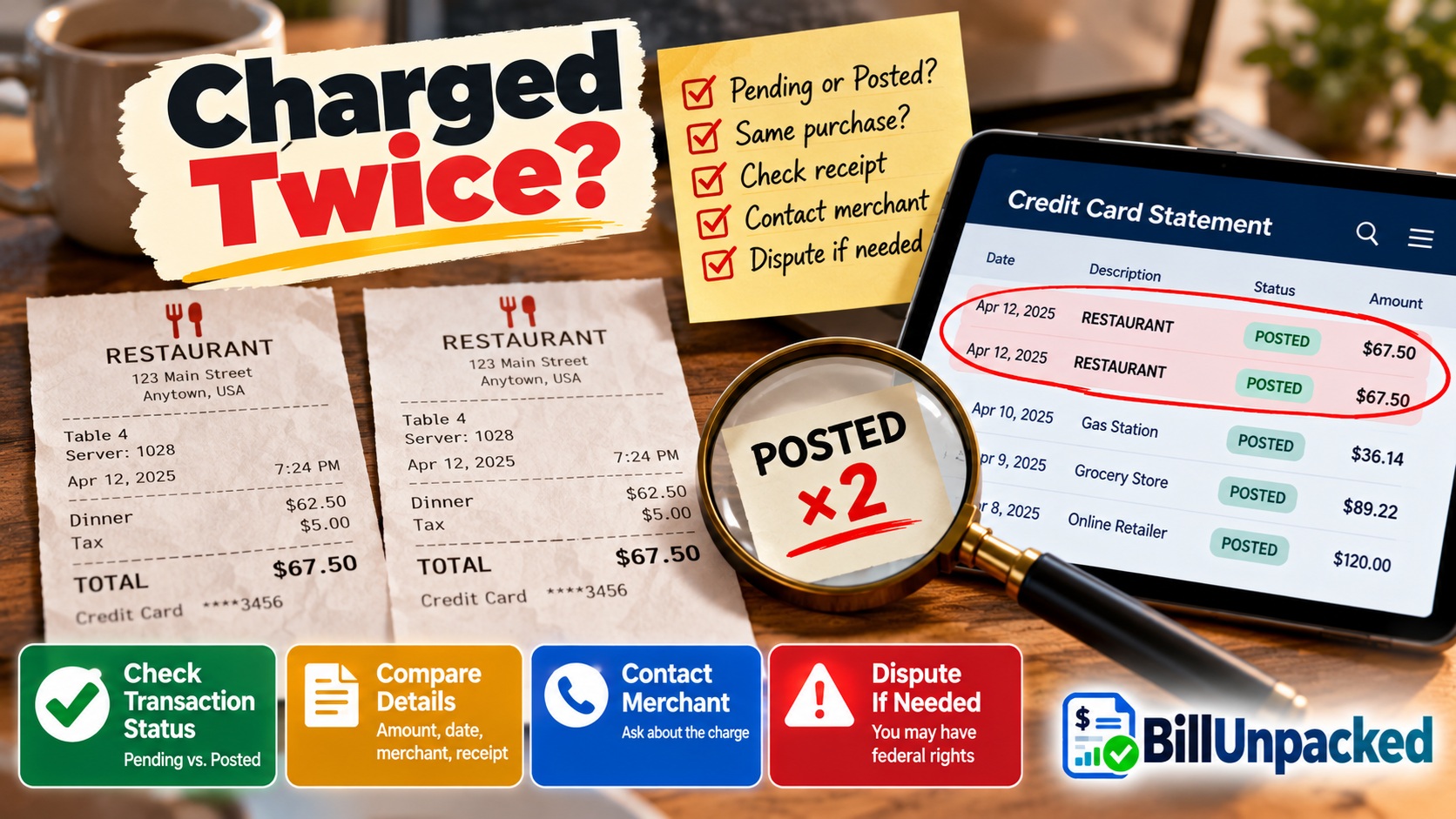
Seeing the same credit card charge twice does not always mean you actually paid twice. First check each transaction’s status. If one entry is pending and the other is posted, you may be seeing an authorization alongside the completed purchase. If two separate charges have both posted for one purchase, you may have a genuine duplicate billing error.
May Not Be a True Duplicate
$79.95 — Pending
$79.95 — Posted
The pending entry may be the earlier authorization. Monitor it to see whether it disappears.
Possible True Duplicate
$79.95 — Posted
$79.95 — Posted
If both completed charges represent one purchase, investigate and dispute the duplicate as appropriate.
Why Is the Same Credit Card Charge Showing Twice?
There are several possible explanations, and the transaction status is the best place to begin.
| What You See | Possible Explanation | Next Step |
|---|---|---|
| One pending + one posted | Authorization may still be displayed beside the final transaction. | Monitor the pending entry. |
| Two posted charges | Possible duplicate billing. | Compare receipts and contact merchant/issuer. |
| Similar amounts, different dates | Could be separate purchases or recurring transactions. | Check receipts and purchase history. |
| Two unfamiliar charges | Could involve unauthorized activity. | Contact your card issuer promptly. |
| One charge + one credit | A correction, reversal or refund may already be processing. | Check the signs and transaction descriptions carefully. |
Pending + Posted: Was I Really Charged Twice?
Not necessarily.
A transaction can first appear as a pending authorization and later become a completed transaction.
Depending on how your issuer displays account activity, there can be a period where the pending authorization and the final posted transaction both appear.
This is one reason you should not identify a duplicate solely because two similar lines are visible.
Our detailed guide explains this processing stage: What Is a Pending Charge on a Credit Card?
What Does a Real Duplicate Charge Look Like?
A stronger sign of duplicate billing is when two completed transactions appear for what was actually one purchase.
For example:
| Transaction | Status | Amount |
|---|---|---|
| Coffee Shop | Posted | $24.80 |
| Coffee Shop | Posted | $24.80 |
| Your receipt | One purchase | $24.80 |
If there was only one purchase and both transactions are completed charges, gather your receipt and investigate.
The FTC specifically includes a situation where a company bills a consumer twice for the same thing among credit-card billing errors covered by the federal dispute process.
Why Do Duplicate Credit Card Charges Happen?
The account display alone usually cannot tell you exactly why two charges occurred.
Possible situations include:
- A pending authorization appearing beside the final charge
- The merchant accidentally submitting the transaction more than once
- A payment attempt being repeated
- Two genuinely separate purchases with similar amounts
- A recurring payment occurring near another purchase
- An unfamiliar or unauthorized transaction
Can an Authorization Hold Look Like a Duplicate Charge?
Yes.
An authorization hold can temporarily reserve available credit before the transaction is finally settled.
If the final transaction appears while the original authorization is still visible, the account can look as though the merchant charged you twice.
Read: What Is an Authorization Hold on a Credit Card? to understand how holds work.
What If the Pending Duplicate Disappears?
If one of the two transactions is pending, it may eventually disappear rather than become a second posted charge.
That can happen when an authorization is released, reversed, expires, or is replaced as the final transaction is processed.
We explain that situation separately in: Why Did My Pending Credit Card Charge Disappear?
Duplicate Charge Checker
This calculator does not determine whether transactions are legally duplicates. It simply shows how much money is involved if the same amount was posted multiple times.
Calculate the Possible Duplicate Amount
Enter the amount of one purchase and the number of posted copies.
What Should I Do If I Was Charged Twice?
Start by gathering evidence instead of immediately assuming fraud.
Duplicate Charge Checklist
- Confirm whether both transactions are posted.
- Compare the merchant names.
- Compare the transaction amounts.
- Compare transaction and posting dates.
- Find the original receipt or order confirmation.
- Check whether you actually made two purchases.
- Look for a refund or credit already being processed.
- Save screenshots of the account activity.
- Contact the merchant and card issuer as appropriate.
Should I Contact the Merchant First?
If you recognize the merchant and believe it simply billed the same purchase twice, contacting the merchant can sometimes resolve the problem quickly.
Ask:
- Do you see two completed transactions?
- Were both submitted for settlement?
- Was one already voided or refunded?
- Can you provide confirmation of the correction?
Keep a record of whom you spoke with and any refund or cancellation reference.
Can I Dispute a Duplicate Credit Card Charge?
Yes, a genuine duplicate can qualify as a billing error.
FTC guidance specifically lists being charged more than once for something among reasons a credit-card charge may be incorrect.
The CFPB recommends contacting your credit card company promptly when you identify a billing mistake.
You can often start by calling customer service or using your issuer’s online dispute process.
What Is the 60-Day Rule for Credit Card Disputes?
For federal billing-error protections, both the CFPB and FTC emphasize the importance of written notice.
The CFPB says that to protect your rights, you must send a written billing-error notice to the card company within 60 calendar days after the charge appeared on your statement.
Use the billing-dispute address shown on your statement or provided by your card company. It may be different from the address used for payments.
What Should I Include in a Duplicate-Charge Dispute?
FTC guidance says a written dispute should include information such as your identifying account information, the disputed dollar amount, the date and an explanation of why the charge is wrong.
For a duplicate charge, useful supporting material can include:
- A copy of the receipt
- Order confirmation
- Screenshot showing both posted transactions
- Merchant correspondence
- Refund or cancellation confirmation
Send copies of supporting records rather than giving away your originals.
How Long Does a Credit Card Company Have to Investigate?
After receiving a qualifying written billing-error notice, CFPB guidance says the issuer generally has 30 days to acknowledge it, unless the matter has already been resolved.
The CFPB says the issuer then gets up to another two billing cycles to finish investigating. FTC guidance describes the resolution deadline as within two billing cycles and no more than 90 days after receiving the complaint. :contentReference[oaicite:1]{index=1}
You remain responsible for paying the undisputed portions of your bill on time.
Do I Have to Pay the Duplicate Charge During the Investigation?
Under the federal billing-error process, CFPB guidance says you do not have to pay the disputed charge or related finance or other charges while the issuer investigates, but you must continue paying correct, undisputed charges on time.
Follow the dispute requirements carefully to preserve those protections.
What If the Duplicate Charge Is Unauthorized?
A merchant accidentally billing the same legitimate purchase twice is different from seeing transactions you never authorized.
If you do not recognize the purchase at all, contact your card issuer promptly using the number on the back of the card, its official app, or its official website.
What If I Already Paid the Credit Card Bill?
Paying the bill does not necessarily eliminate your ability to dispute an incorrect credit-card charge.
The CFPB says you can still dispute a charge you have already paid, although you may not receive the money back until the card company determines that your dispute is valid. :contentReference[oaicite:2]{index=2}
What If the Merchant Says It Already Refunded Me?
Ask the merchant for documentation of the refund and then monitor your card account.
Keep in mind that a refund is different from a pending authorization disappearing.
Look for an actual credit/refund associated with the corrected transaction.
Duplicate Credit Card Charge vs. Duplicate Debit Card Charge
Do not automatically use credit-card dispute rules for a debit-card problem.
The FTC specifically warns that consumer protections for debit cards are different from those for credit cards. :contentReference[oaicite:3]{index=3}
This BillUnpacked guide is focused on credit cards.
Example: Is This a Duplicate?
| Scenario | Likely Next Step |
|---|---|
| $120 pending + $120 posted | Monitor the pending authorization. |
| $120 posted + $120 posted for one purchase | Investigate as a possible duplicate billing error. |
| $120 posted + -$120 credit | Check whether the merchant already corrected it. |
| Two $120 posted charges but two separate receipts | They may be legitimate separate purchases. |
| Two $120 charges you don’t recognize | Contact the issuer promptly about possible unauthorized activity. |
Bottom Line
If you see a duplicate credit card charge, first determine whether you actually have two completed charges.
One pending transaction plus one posted transaction may simply reflect authorization and settlement.
But if the same purchase appears as two separate posted charges, gather your receipt, contact the merchant and promptly use your credit-card issuer’s dispute process if necessary.
Most importantly, don’t ignore a genuine billing error. Federal credit-card protections have deadlines, including the CFPB’s guidance to send written billing-error notice within 60 days after the statement containing the disputed charge was sent to you.
Authoritative U.S. Sources
Consumer Financial Protection Bureau:
How to Fix Mistakes in Your Credit Card Bill
Consumer Financial Protection Bureau:
How Do I Dispute a Charge on My Credit Card Bill?
Federal Trade Commission:
Using Credit Cards and Disputing Charges
Federal Trade Commission:
Sample Letter for Disputing Card Charges