
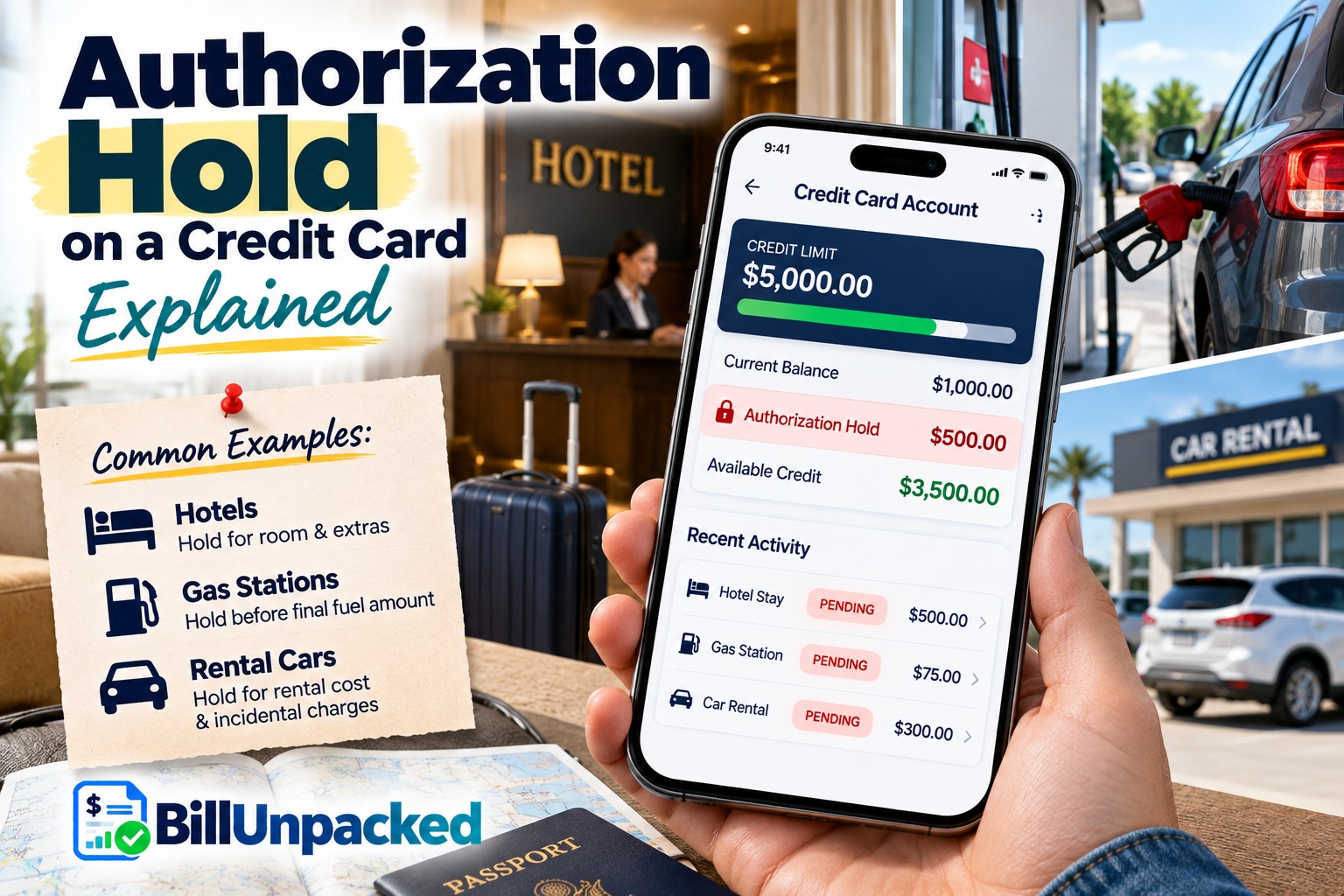
An authorization hold on a credit card is a temporary amount associated with a merchant’s request to confirm that your card account is valid and sufficient credit is available. The hold can temporarily reduce your available credit, but it is not necessarily the final amount that will eventually post to your account.
How Does an Authorization Hold Work?
When you use a credit card, a merchant can ask the card issuer to authorize the transaction.
The Consumer Financial Protection Bureau explains that authorization tells a merchant that the account is valid and that sufficient credit is available to cover the purchase.
A simple transaction may look like this:
Card Used
You present the credit card.
Authorization
The merchant requests an amount.
Settlement
A final transaction posts or the hold is released.
During the middle stage, the authorization may appear as a pending transaction in your online account.
For more about the pending status itself, read: What Is a Pending Charge on a Credit Card?
Is an Authorization Hold an Actual Charge?
Not necessarily.
An authorization hold and a final posted transaction are related but should not automatically be treated as the same thing.
| Authorization Hold | Posted Charge |
|---|---|
| Temporary authorization amount | Completed transaction recorded to the account |
| May reduce available credit | Becomes part of posted account activity |
| Can differ from final purchase amount | Reflects the amount submitted for final processing |
| Can eventually be released | Does not disappear merely because the earlier hold is released |
Does an Authorization Hold Reduce Available Credit?
An authorization can temporarily reduce the amount of credit available for other purchases.
For example:
| Example | Amount |
|---|---|
| Credit limit | $5,000 |
| Posted balance | $1,000 |
| Hotel authorization hold | $500 |
| Illustrative available credit | $3,500 |
Your issuer determines the actual available-credit calculation shown on your account.
Authorization Hold Calculator
Estimate the Effect of a Hold
See how a temporary authorization could affect your available credit.
Why Do Hotels Put Authorization Holds on Credit Cards?
A hotel may not know the exact final amount it will need to collect when you first check in.
For example, the final bill could potentially include the room charge plus other amounts associated with the stay.
A hotel can therefore request an authorization amount before the final transaction is submitted.
Consider this fictional example:
| Hotel Example | Amount |
|---|---|
| Expected room total | $600 |
| Additional amount included in authorization | $200 |
| Initial authorization | $800 |
| Final hotel bill | $650 |
In this fictional example, the $800 authorization should not automatically be interpreted as the final hotel bill.
Why Do Rental Car Companies Place Holds?
The Federal Trade Commission specifically warns consumers that rental-car companies commonly place a hold, or block, on a debit or credit card for more than the agreed rental cost.
According to the FTC, companies do this to help ensure sufficient money or credit is available to cover the final bill, including possible additional charges.
The FTC also notes that if you are near your credit limit, a block can affect your ability to make additional purchases.
Why Do Gas Stations Use Authorization Holds?
At a pay-at-the-pump transaction, the exact amount of fuel you will purchase is not necessarily known when the card is first presented.
Federal credit-card regulations explicitly recognize situations in which a gas-station authorization amount differs from the final settlement amount.
For example, CFPB Regulation Z commentary includes an example where a merchant requests a small authorization before a larger final fuel purchase is settled.
The important point is that the authorization amount and final fuel purchase can be different.
Can a Restaurant Put an Authorization on a Card?
Restaurant transactions can involve an initial authorization before the final transaction reflects the completed total, including an added tip where applicable.
Compare the final posted transaction with your receipt rather than assuming the first pending amount is the final charge.
Why Is the Authorization Hold Higher Than My Purchase?
A hold can exceed the amount you initially expect to spend when the merchant does not yet know the final transaction amount or wants authorization sufficient to cover potential additional charges.
This can be particularly relevant with:
- Hotels
- Rental cars
- Fuel purchases
- Restaurants
- Transactions where the final total is determined later
Ask the merchant what amount it requested and why.
How Long Does an Authorization Hold Last?
There is no single universal hold period for every credit-card transaction.
The timing can depend on the merchant, issuer, transaction type and how quickly the final transaction is submitted or the authorization is released.
Why Is the Hold Still There After I Paid?
The merchant completing a transaction and your card issuer updating the displayed authorization are not necessarily instantaneous events.
If the final charge has posted but an associated hold still appears, monitor the account and contact your issuer if it does not resolve as expected.
Ask whether the issuer can identify the merchant authorization and the final posted transaction as related.
Why Do I See Both a Hold and a Posted Charge?
You may temporarily see both an authorization and a final transaction.
That can make the account appear as though the merchant charged you twice even when one entry is only a pending authorization.
Check the status carefully:
| Transaction | Status | What to Do |
|---|---|---|
| $200 Hotel | Pending | Could be an authorization; monitor it. |
| $165 Hotel | Posted | Compare with final receipt. |
| Both remain posted | Completed | Investigate as possible separate or duplicate transactions. |
Can I Ask a Merchant to Remove an Authorization Hold?
You can contact the merchant and ask whether it has completed, canceled or released the authorization on its side.
You can also contact the card issuer to ask how the authorization is being handled.
But do not assume either party can always make the hold disappear from your account immediately.
The processing path and timing depend on the transaction and the systems involved.
What If a Hotel Says It Released the Hold?
Ask the hotel when it released the authorization and whether it can provide documentation or a reference for the transaction.
Then contact the card issuer if the hold continues to affect your available credit.
Provide:
- Merchant name
- Authorization amount
- Date of authorization
- Final posted amount, if any
- Any release confirmation from the merchant
Is an Authorization Hold the Same as a Security Deposit?
Not necessarily.
A merchant may use an authorization hold as part of how it protects itself against potential additional costs, but the concepts should not automatically be treated as identical.
Ask whether the business is actually collecting a deposit or merely requesting temporary card authorization.
What If I Don’t Recognize the Authorization Hold?
An unfamiliar authorization deserves attention.
Check whether:
- The merchant uses a different billing name
- You recently stayed at a hotel
- You rented a vehicle
- You bought fuel
- Another authorized cardholder made the transaction
- The amount relates to a purchase you recently made
If you still believe the transaction is unauthorized, contact the card issuer promptly through a trusted channel.
Authorization Hold Checklist
Check These 9 Things
- Is the transaction pending or posted?
- What merchant requested the authorization?
- What amount was authorized?
- What was your actual purchase amount?
- Did the merchant explain an incidental or additional amount?
- Has the final transaction already posted?
- Is the hold reducing available credit?
- Has the merchant confirmed it released the authorization?
- Do you recognize and authorize the transaction?
Authorization Hold vs. Pending Charge
These terms are closely related but describe different aspects of a transaction.
An authorization hold refers to the temporary authorization that can reserve available credit.
A pending charge describes how an unfinished transaction may appear in your card account.
For a complete explanation of the second term, see: What Is a Pending Charge on a Credit Card?
Bottom Line
An authorization hold on a credit card is generally a temporary authorization connected to a transaction before final processing is complete.
It can reduce your available credit, and the authorized amount does not necessarily have to match the eventual posted amount.
This is especially relevant with hotels, rental cars, gas stations and other transactions where the final total may not be known immediately.
If a hold seems wrong, identify the merchant, authorization amount, final transaction and current status before assuming you have been charged twice.
Authoritative U.S. Sources
Consumer Financial Protection Bureau:
How Credit Card Authorization Works
Consumer Financial Protection Bureau:
Regulation Z — Authorization and Settlement Example
Federal Trade Commission:
Renting a Car — Debit and Credit Card Blocking