
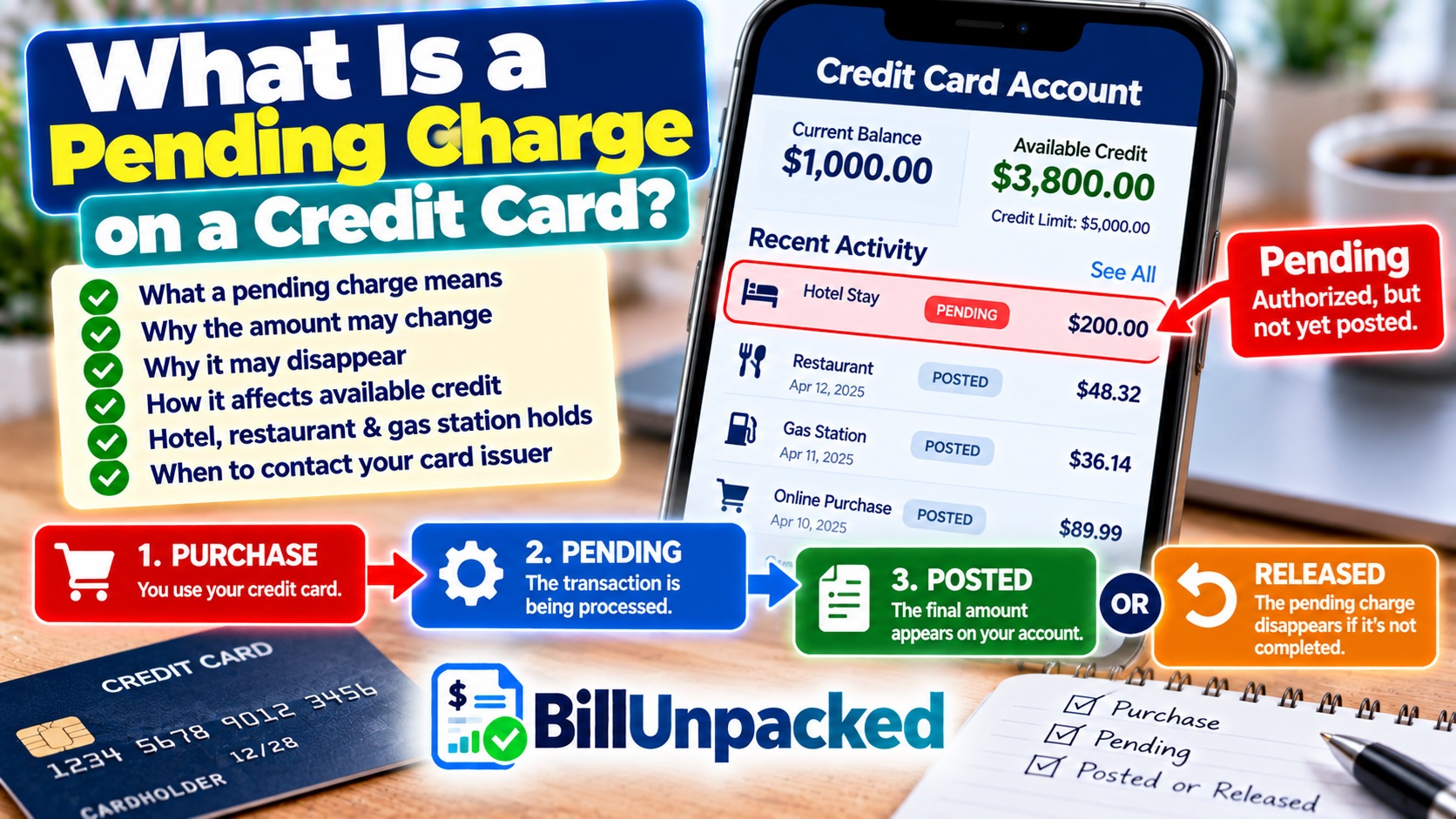
A pending charge on a credit card generally means a transaction has been authorized or initiated but has not yet finished posting to your account. The amount may reduce your available credit while it is pending. It can later post, change to a different final amount, or disappear if the transaction is not completed.
What Does “Pending” Mean on a Credit Card?
When you make a card purchase, the merchant can request authorization from the card issuer.
The CFPB explains that when a credit card is used at a store, the merchant generally obtains authorization from the issuer. That authorization helps establish that the account is valid and that sufficient credit is available for the purchase.
Your account may display the transaction as pending before it becomes a completed or posted transaction.
Purchase
You use the card.
Pending
Authorization/processing appears.
Posted or Released
The transaction is finalized or the pending authorization disappears.
Pending vs. Posted Credit Card Charge
| Pending Charge | Posted Charge |
|---|---|
| Still being processed | Recorded as a completed transaction |
| Amount may still change in some situations | Shows the finalized posted amount |
| May disappear without becoming a posted charge | Remains in completed transaction history unless later credited or otherwise adjusted |
| Can affect available credit depending on issuer handling | Part of the posted account activity |
Does a Pending Charge Reduce Available Credit?
A pending authorization can reduce the credit currently available to you even though the transaction has not yet posted.
Consider this simple example:
| Example | Amount |
|---|---|
| Credit limit | $5,000 |
| Posted balance | $1,000 |
| Pending authorizations | $200 |
| Illustrative available credit | $3,800 |
Your issuer’s actual available-credit calculation and timing control what you see in your account.
Pending Charge Calculator
Estimate Available Credit
Enter your credit limit, posted balance and pending authorizations.
How Long Does a Credit Card Charge Stay Pending?
There is no single universal pending period that applies to every credit card transaction.
Timing can depend on the merchant, card issuer, transaction type and whether the merchant completes the transaction.
For that reason, be cautious with claims that every pending transaction must disappear or post within an exact number of days.
Why Did My Pending Charge Disappear?
A pending authorization can disappear if the merchant does not complete it or if that particular authorization is released.
That does not always mean you received the purchase for free.
A completed transaction can potentially appear separately later depending on what occurred between the merchant and card issuer.
Continue checking your account before assuming the transaction has permanently vanished.
Why Did the Pending Amount Change?
In some transactions, the amount initially authorized can differ from the final purchase amount.
This is particularly important when the final amount cannot be known precisely at the moment the card is first presented.
Examples can include:
- Hotels
- Restaurants
- Gas stations
- Car rentals
- Other merchants using estimated or additional authorizations
Why Do Hotels Put Pending Charges on Credit Cards?
Hotels may request an authorization related to your stay and possible additional expenses.
The authorization you initially see should not automatically be interpreted as the final hotel charge.
After checkout and final processing, your account may show a different posted amount and the earlier authorization may be released.
Why Do Gas Stations Show a Different Pending Amount?
Some pay-at-the-pump transactions can involve an authorization before the final amount of fuel purchased is known.
The initial authorization and the final posted fuel purchase therefore may not always look identical.
If the authorization remains after the final transaction appears, monitor the account and contact the issuer if it does not resolve as expected.
What About Restaurant Pending Charges and Tips?
A restaurant transaction can also change between initial authorization and final processing when a tip is added.
For example, you might initially see an amount associated with the meal and later see the completed transaction reflect the final total.
Use the final receipt to compare against the eventual posted amount.
Why Do I See a Pending Charge and a Posted Charge?
Sometimes an account can temporarily display an authorization and a completed transaction in a way that looks like two charges.
Do not immediately assume you were charged twice.
Check whether:
- One transaction is marked pending
- The other is marked posted or completed
- The amounts are identical or related
- The pending authorization later disappears
Can a Pending Credit Card Charge Be Canceled?
Whether a pending transaction can be stopped or reversed depends on the circumstances, merchant and issuer.
If you made the purchase but now want to cancel it, contact the merchant first and ask whether the transaction or order can still be canceled.
A merchant cancellation does not necessarily cause the pending authorization to disappear from your card account instantly.
What If I Don’t Recognize a Pending Charge?
Treat an unfamiliar pending transaction seriously, especially if you have no reason to recognize the merchant or amount.
First check:
- Whether the merchant uses a different billing name
- Whether another authorized cardholder made the purchase
- Whether it relates to a recent online order
- Whether it is connected to a hotel, gas station or restaurant authorization
If you believe the transaction is unauthorized, contact your card issuer promptly through a trusted channel.
Is a Pending Charge the Same as an Unauthorized Charge?
No.
“Pending” describes the transaction’s processing status. “Unauthorized” describes whether the card use was permitted.
A legitimate purchase can be pending, and an unauthorized transaction can also initially appear as pending.
The CFPB generally describes unauthorized use as use of a credit card by someone who does not have the right to use it.
Should I Dispute a Pending Charge?
If you recognize the transaction but disagree with something such as the final amount, first determine whether you are looking at a pending authorization or a completed transaction.
For an unauthorized or suspicious transaction, however, contact the card issuer promptly rather than waiting simply because the transaction says “pending.”
Your issuer can explain what actions are available while the transaction is pending.
What If the Wrong Amount Posts?
Once the transaction posts, compare it with your receipt or other purchase record.
If the posted amount is incorrect, contact the card issuer promptly.
The CFPB advises consumers to call the card company about a disputed credit-card charge and explains that, to protect federal billing-error rights, a written billing-error notice generally must be sent within 60 calendar days after the charge appeared on the statement.
Follow the dispute instructions on your own statement because the billing-dispute address can differ from the payment address.
What Happens After a Credit Card Billing Dispute?
For qualifying credit-card billing errors, CFPB guidance says the issuer generally has 30 days to acknowledge a written dispute unless the required resolution has already been completed.
The investigation generally must be completed within the applicable federal billing-error timeframe, which can extend through two billing cycles.
Continue paying undisputed amounts according to your account requirements while the dispute is being handled.
Pending Charge Checklist
Check These Before Taking Action
- Is the transaction marked pending or posted?
- Do you recognize the merchant?
- Does the amount match a recent purchase?
- Could it be a hotel, gas station or restaurant authorization?
- Did another authorized cardholder make the purchase?
- Has the final transaction already posted separately?
- Is the transaction affecting your available credit?
- Do you have the receipt or order confirmation?
- If suspicious, have you contacted the card issuer?
Pending Credit Card Charge: Bottom Line
A pending charge on a credit card usually indicates that a transaction is still being processed rather than being a finalized posted transaction.
The pending amount can affect your available credit and, depending on the transaction, may later post for the same or a different amount or the authorization may disappear.
Do not assume that every pending charge is an error, duplicate charge or fraud. Check the merchant, amount and transaction status first.
But if you do not recognize the transaction or believe your card information has been used without permission, contact your card issuer promptly.
Authoritative U.S. Sources
Consumer Financial Protection Bureau:
How Credit Card Authorization Works
Consumer Financial Protection Bureau:
How to Dispute a Credit Card Charge
Consumer Financial Protection Bureau:
How to Fix Mistakes in Your Credit Card Bill
Federal Trade Commission:
Using Credit Cards and Disputing Charges