
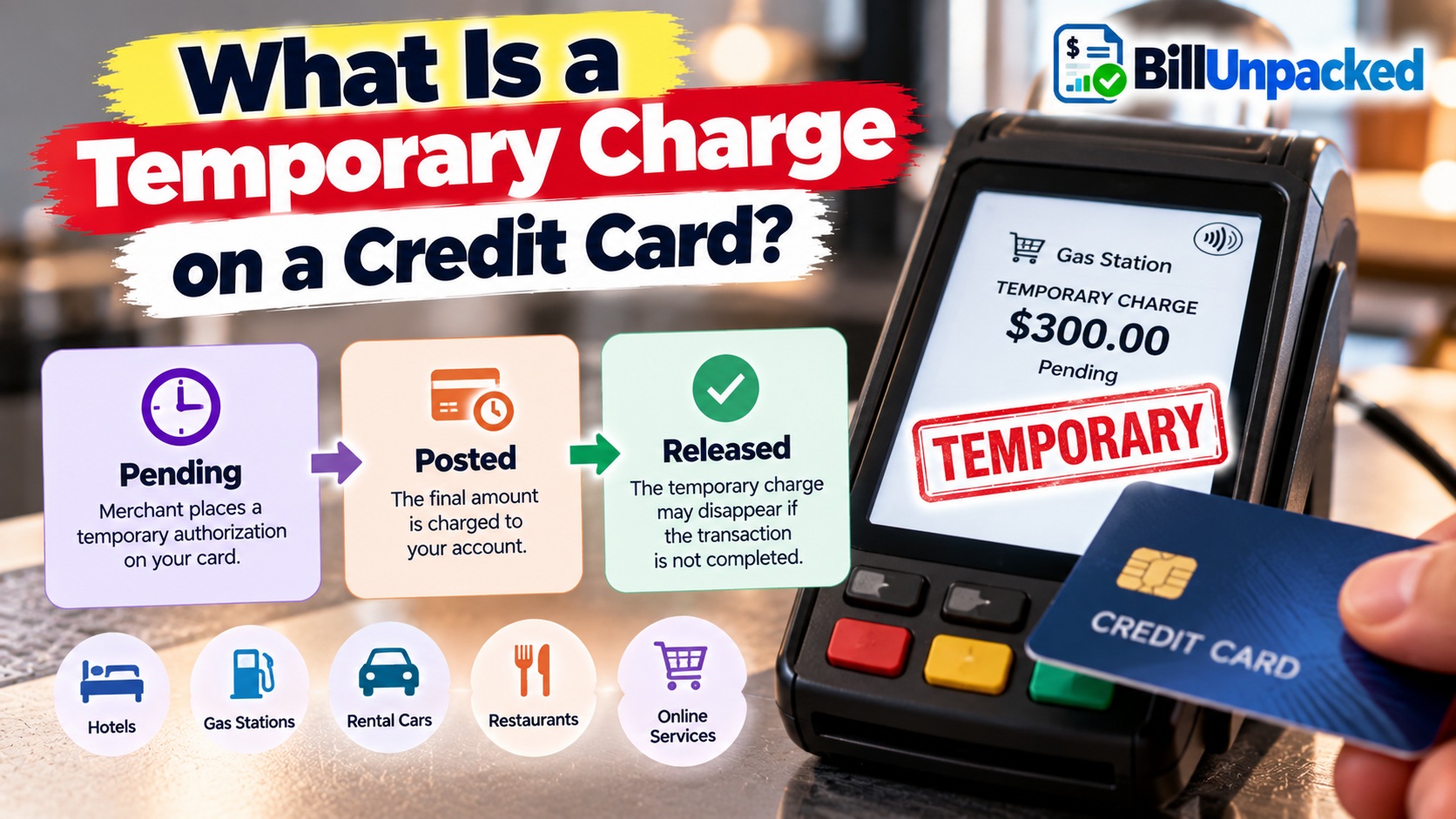
A temporary charge on a credit card often means a merchant requested an authorization that has not yet become a final posted transaction. It may appear as pending and temporarily reduce your available credit. The amount can later post, change or disappear. However, “temporary charge” is not one universal banking status, so check the transaction status and your card issuer’s explanation before assuming what it represents.
What Does “Temporary Charge” Actually Mean?
The phrase can be confusing because it is not necessarily the formal transaction status used by every card issuer.
In many situations, what consumers call a temporary charge is a pending authorization or authorization hold.
When you use a credit card, the merchant can request authorization from the card issuer. The authorization confirms whether the account can approve the transaction.
The CFPB explains that when a credit card is used at a store, the merchant normally obtains authorization from the issuer, which confirms that the account is valid and sufficient credit is available for the purchase.
Temporary Does Not Automatically Mean Fake
A legitimate transaction may temporarily appear before the merchant finalizes the payment. But an unfamiliar temporary or pending transaction should still be reviewed rather than ignored.
Temporary Charge vs. Posted Charge
| Feature | Temporary / Pending Authorization | Posted Charge |
|---|---|---|
| Status | Not yet fully processed | Finalized on the account |
| Available credit | May be reduced | Reflected in account balance |
| Amount | May sometimes change | Final transaction amount, subject to later refund/dispute activity |
| Can disappear? | Yes, an authorization may be released | Normally requires a refund, reversal or other account adjustment to undo |
| Dispute process | Issuer procedures vary while pending | Normal posted-transaction dispute procedures can apply |
Why Do Merchants Place Temporary Charges?
There are several legitimate reasons a merchant may request an authorization before the final amount is known.
Hotels
Hotels may authorize an amount covering the expected room cost plus an additional amount for possible incidentals.
The final charge can differ from the initial authorization.
Gas Stations
When paying at the pump, the station may not know how much fuel you will purchase when the card is first authorized.
A temporary authorization may therefore appear before the actual fuel amount is finalized.
Rental Cars
Rental businesses may use authorization holds because the final amount can depend on the completed rental and applicable charges.
Restaurants
A restaurant transaction may initially be authorized before the final amount—including an added tip—is processed.
Online Services and Card Verification
Some services may request a small authorization to verify that a card is valid.
For example, PayPal currently explains that when a card is added or edited, it may place a temporary authorization of up to $1 to verify the card for online payments. The transaction remains pending rather than being collected as a normal purchase.
Does a Temporary Charge Reduce Available Credit?
It can.
Capital One explains that pending credit-card transactions are subtracted from available credit while pending, although they are not yet added to the account balance as finalized transactions.
Consider this fictional example:
| Credit Detail | Amount |
|---|---|
| Credit limit | $5,000 |
| Posted balance | $1,500 |
| Temporary authorization | $300 |
| Illustrative available credit | $3,200 |
If the $300 authorization is released without becoming a posted transaction, the corresponding available credit may become available again, assuming no other account activity.
Temporary Charge Calculator
Use this calculator to see how a pending authorization can affect available credit.
How Much Credit Is Temporarily Unavailable?
Enter your credit limit, posted balance and temporary authorization.
How Long Does a Temporary Charge Stay?
There is no universal duration that applies to every card, merchant and transaction.
The processing time depends on factors such as the merchant, transaction type, card network and issuer.
As one issuer-specific example, Capital One currently says its transactions usually post within 72 hours, although some can take up to five days.
That is an example of one issuer’s guidance—not a universal deadline for all credit cards.
Can a Temporary Charge Disappear?
Yes.
If a merchant does not complete the transaction, an authorization can be released instead of becoming a posted charge.
This can make the pending transaction disappear from the account.
For a deeper explanation, see: Why Did My Pending Credit Card Charge Disappear?
Can the Final Charge Be Different?
Yes, in transactions where the final amount was not known when the initial authorization was requested.
Common examples include:
- A restaurant adding the authorized tip
- A hotel finalizing room and incidental charges
- A gas station replacing a pump authorization with the fuel purchase
- A rental company finalizing the completed rental
Capital One specifically notes that restaurants, gas stations, hotels and rental agencies are examples where pending and final amounts can differ.
Why Do I See Both a Temporary and Final Charge?
Sometimes the authorization has not disappeared yet when the final transaction appears.
That can temporarily look like two charges.
Check the status of each transaction:
- Is one pending?
- Is the other posted?
- Are both actually posted?
If both transactions become posted and you believe you were charged twice, use our guide: Duplicate Credit Card Charge? What to Do.
Temporary Charge vs. Authorization Hold
In everyday consumer language, these phrases are often used for the same situation.
An authorization hold is more precise: an amount is authorized and temporarily affects available credit while the merchant determines whether and how much to capture.
Read: What Is an Authorization Hold on a Credit Card?
Temporary Charge vs. Reversal
These describe different stages.
A temporary authorization is the initial hold. An authorization reversal can release an authorization when the merchant no longer needs it or the amount needs to be changed.
Read: Reversed Credit Card Charge: What Does It Mean?
What If I Don’t Recognize the Temporary Charge?
Capital One’s current guidance, for example, tells customers to start its fraud-claim process immediately for a pending transaction that was not authorized by the cardholder or another person on the account.
Your own issuer’s procedure may differ, so follow its instructions.
What If the Temporary Charge Becomes an Incorrect Posted Charge?
Once a transaction posts, federal billing-error protections may become relevant.
The CFPB recommends contacting the card company promptly about an incorrect credit-card charge. To protect federal billing-error rights, CFPB says to also send the required written billing-error notice no later than 60 days after the issuer sent the statement on which the error first appeared.
Follow the billing-error instructions on your statement because the dispute address may be different from the payment address.
What Should I Do About a Temporary Charge?
Quick Checklist
- Check whether the transaction says pending or posted.
- Confirm that you recognize the merchant.
- Compare the amount with your receipt or reservation.
- Think about recent hotels, gas stations, rentals or restaurants.
- Check whether the merchant disclosed an authorization hold.
- Watch for the final posted amount.
- Check whether a pending authorization disappears.
- Contact the merchant if an authorized transaction amount seems wrong.
- Contact the card issuer promptly for an unauthorized transaction.
- If an incorrect charge posts, review your issuer’s dispute procedure.
Bottom Line
A temporary charge on a credit card often represents a pending authorization rather than a finalized purchase.
It can temporarily reduce available credit and may later post, change or disappear.
The key is to check the transaction status. A recognized pending authorization may simply be part of normal card processing. An unfamiliar transaction deserves prompt attention from the card issuer.
Authoritative Sources
Consumer Financial Protection Bureau:
How Credit Card Authorization Works
Consumer Financial Protection Bureau:
How to Fix Mistakes in Your Credit Card Bill
Capital One:
Pending Credit Card Transactions