
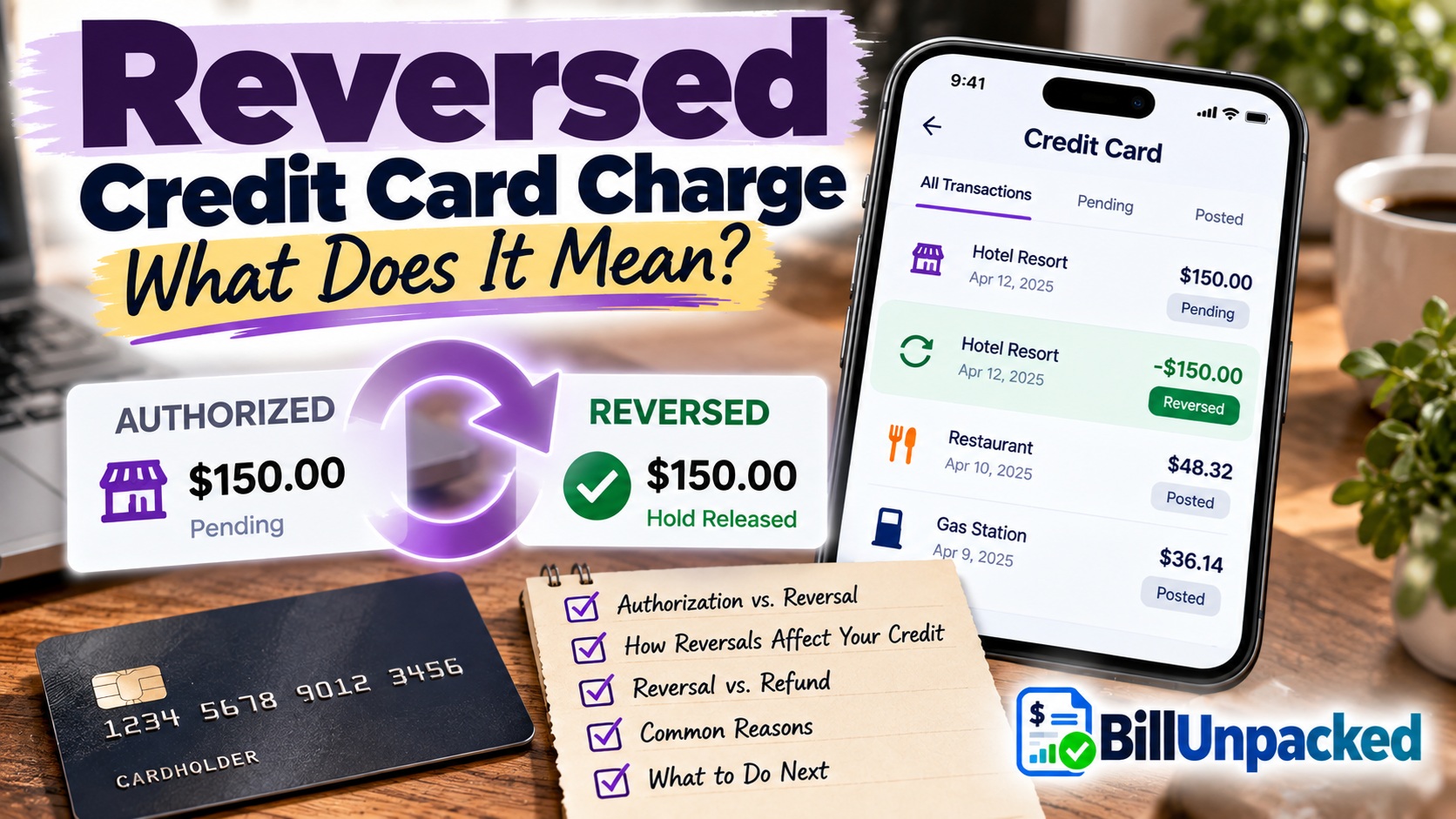
A reversed credit card charge generally means a card transaction or authorization was undone rather than continuing through its original payment path. But the word “reversed” can describe different stages of card processing. An authorization reversal can release a temporary hold before settlement, while a refund returns funds after a transaction has been captured or settled.
What Does “Reversed” Mean on a Credit Card?
The exact wording shown in a banking app varies by card issuer, so “reversed” should not be interpreted from the label alone.
In card processing, however, an authorization reversal has a specific purpose.
Visa Acceptance Solutions explains that an authorization reversal cancels all or part of an approved authorization that has not been captured and requests release of the authorization hold.
The original authorization may have temporarily reduced your available credit even though funds had not yet been transferred to the merchant.
Reversal vs. Refund vs. Void: What’s the Difference?
These terms are often used casually as though they mean the same thing. Technically, they can occur at different stages of the payment lifecycle.
| Transaction Action | When It Generally Happens | What It Does |
|---|---|---|
| Authorization reversal | Before an approved authorization has been captured | Requests release of all or part of the authorization hold. |
| Void | Before an eligible follow-on transaction is submitted for settlement | Cancels an eligible payment-related transaction before settlement. |
| Refund | After funds have been captured or settled | Returns funds to the customer. |
| Chargeback | Part of a dispute/payment-resolution process | Is not simply another name for a merchant refund or authorization reversal. |
Visa’s current payment documentation specifically distinguishes authorization reversals, voids and refunds based on the transaction’s stage.
Why Would a Credit Card Charge Be Reversed?
There is no single cause. The reason depends on the merchant, transaction status and payment processing.
Other situations can include:
- A merchant voiding an eligible transaction before settlement
- A hotel or rental-car authorization being adjusted after the final amount is known
- An online order changing before shipment
- A merchant deciding not to complete an earlier authorization
- A payment-processing correction
Does a Reversed Credit Card Charge Mean I Got a Refund?
Not necessarily.
This is one of the most important distinctions for consumers.
Visa says an authorization reversal requests release of the hold associated with the original authorization before settlement.
A credit or refund, by contrast, returns funds after the applicable transaction has been captured, settled or transmitted for settlement.
| If You See… | What May Have Happened |
|---|---|
| Pending charge disappears | An authorization may have been released, reversed or expired. |
| Authorization marked reversed | The hold associated with an approved authorization may be released. |
| Posted purchase + separate credit | This may represent a refund or account credit. |
| Posted purchase disappears/changes | Check the issuer’s transaction details because display conventions vary. |
Does a Reversal Restore Available Credit?
An authorization can temporarily reduce the credit available to you.
When an authorization reversal successfully releases that hold, the reserved amount can become available again, subject to your issuer’s processing.
For example:
| Illustrative Account | Amount |
|---|---|
| Credit limit | $5,000 |
| Posted balance | $1,500 |
| Authorization hold | $400 |
| Illustrative available credit with hold | $3,100 |
| Illustrative available credit after $400 hold release | $3,500 |
Your actual available credit is determined by your card issuer and may reflect other transactions, payments, holds or account activity.
Authorization Reversal Calculator
Estimate the Effect of a Released Hold
This calculator illustrates how releasing an authorization hold could affect available credit.
How Long Does a Credit Card Reversal Take?
There is no universal number of days that applies to every authorization reversal.
Visa Acceptance Solutions states that authorization-hold expiration times vary by issuing bank. Visa also notes that the issuer has its own rules for deciding whether an authorization reversal succeeds or fails.
Therefore, avoid assuming that every reversal must restore available credit within the same fixed timeframe.
Can a Reversed Credit Card Charge Come Back?
It depends on what was reversed and what happens with the underlying purchase.
For example, releasing an authorization hold is not the same thing as declaring that you never owe the merchant for goods or services you actually purchased.
If you still expect the merchant to complete the transaction, continue monitoring the account for a final posted charge.
Why Was My Online Order Reversed?
If an online purchase was canceled before completion, an authorization may no longer be needed.
Check the retailer’s order page for statuses such as:
- Canceled
- Processing
- Backordered
- Partially shipped
- Shipped
If the order is still active, do not assume that a vanished authorization means the merchandise is free.
Why Was My Hotel Charge Reversed?
Hotels can use authorization holds because the amount known at check-in may differ from the final bill.
Once the final amount is determined, the original authorization can be adjusted or released as the final transaction is processed.
Compare your final hotel receipt with your eventual posted card activity.
For more detail, read What Is an Authorization Hold on a Credit Card?.
Why Was My Gas Station Charge Reversed?
A pay-at-the-pump transaction can begin with an authorization before the exact amount of fuel purchased is known.
The initial authorization therefore may not be the same as the final fuel transaction.
If the earlier authorization is released or replaced, check your completed transactions for the actual purchase amount.
Reversed Charge vs. Disappeared Pending Charge
These situations can be closely related.
A pending charge can disappear when its authorization is released, reversed or expires. But a banking app may not explicitly label that event as a “reversal.”
See our guide: Why Did My Pending Credit Card Charge Disappear?
Reversed Charge vs. Duplicate Charge
A reversal can also matter when investigating an apparent duplicate.
For example, you might temporarily see an earlier authorization plus a final posted transaction. If the earlier authorization is released, the apparent duplicate may disappear.
However, two completed charges for one purchase can be a genuine billing problem.
See: Duplicate Credit Card Charge? What to Do
What If the Merchant Says It Reversed the Charge?
Ask the merchant:
- Was the transaction an authorization, capture or settled purchase?
- Was an authorization reversal submitted?
- Was the transaction voided?
- Was a refund issued instead?
- Can the merchant provide a confirmation or reference?
Then compare that information with what your card issuer sees.
What If a Reversed Charge Later Posts?
First determine whether the posted transaction represents a legitimate purchase you made.
If the amount is correct and you received the goods or services, the posting may represent completion of the underlying transaction rather than an error.
If the charge is wrong, duplicated or unauthorized, contact the merchant and card issuer as appropriate.
What If the Reversed Charge Was Unauthorized?
Do not ignore suspicious activity simply because a transaction later disappears or is reversed.
If you did not authorize the transaction, contact the card issuer promptly through its official website, app or the number on your card.
What If the Charge Should Have Been Refunded but Wasn’t?
If a completed transaction should have been refunded, check whether the merchant actually issued a refund rather than merely referring to a canceled authorization.
The CFPB recommends first contacting the seller about a refund for a product or service. If the seller does not resolve the problem, you may have options to dispute the charge with your card issuer.
When Should I Dispute the Charge?
If an incorrect transaction becomes a billing error on your credit card statement, federal dispute protections can apply.
CFPB guidance says you should contact the credit card company promptly and, to protect your billing-error rights, send a written notice within the applicable federal deadline.
Under Regulation Z, the issuer must receive the notice no later than 60 days after it transmitted the first periodic statement reflecting the alleged billing error.
Follow the billing-dispute instructions on your statement. The dispute address may be different from the address used for payments.
What Happens After a Billing-Error Notice?
According to the CFPB, after receiving a qualifying written billing-error notice, the issuer generally has 30 days to acknowledge it unless it has already completed the required resolution process. It then gets up to another two billing cycles to complete its investigation.
During the investigation, CFPB guidance says you generally do not have to pay the disputed amount or related charges, but you must continue paying correct, undisputed amounts on time.
Reversed Credit Card Charge Checklist
Check These 9 Things
- Was the original transaction pending or posted?
- Is the reversal a separate account entry?
- Did your available credit increase?
- Is there a final posted purchase?
- Did you cancel the order?
- Did the merchant issue a refund instead?
- Does the amount match your receipt?
- Do you recognize the merchant?
- Is the final statement correct?
Quick Comparison
| Term | Plain-English Meaning |
|---|---|
| Pending | The transaction has not completed posting. |
| Authorization hold | Credit is temporarily reserved following an authorization. |
| Authorization reversal | Requests release of an approved authorization before capture/settlement. |
| Void | Cancels an eligible transaction before the applicable settlement stage. |
| Refund | Returns funds after a transaction has been captured or settled. |
| Posted | The transaction appears in completed account activity. |
Bottom Line
A reversed credit card charge does not automatically mean the same thing as a refund.
If the transaction was still an authorization, a reversal can request release of the temporary hold before settlement. A refund, by contrast, generally returns funds after the payment has already been captured or settled.
Check whether the original transaction was pending or posted, look at your available credit, verify the merchant’s order status and watch for any final transaction.
If the final charge is incorrect, duplicated or unauthorized, contact your issuer promptly and follow the applicable billing-error procedure.
Authoritative Sources
Visa Acceptance Solutions:
Reversing or Deleting an Authorization
Visa Acceptance Solutions:
Understanding Transaction Types
Consumer Financial Protection Bureau:
Credit Card Refund Guidance
Consumer Financial Protection Bureau:
How to Fix Mistakes in Your Credit Card Bill
Federal Trade Commission:
Using Credit Cards and Disputing Charges